Beyond the Visual: Rethinking Sculpture, Touch, and the Politics of Access

On 23 February, Sculpture Network Online Club brought together artists, curators, researchers, and accessibility advocates for a focused discussion on Beyond the Visual — one of the most ambitious curatorial experiments in multisensory sculpture in recent decades.
Speakers of the evening, moderated by the Dutch art critic Anne Berk, were two of the principal investigators of this research project: Dr Aaron McPeake (IE), a blind sculptor who teaches at Chelsea and Camberwell Colleges of Arts, and Dr Ken Wilder (UK), a sighted artist and writer, Professor of Aesthetics at the University of the Arts London and the Rootstein Hopkins Chair of Design.
A Radical Premise: Sculpture Beyond Sight
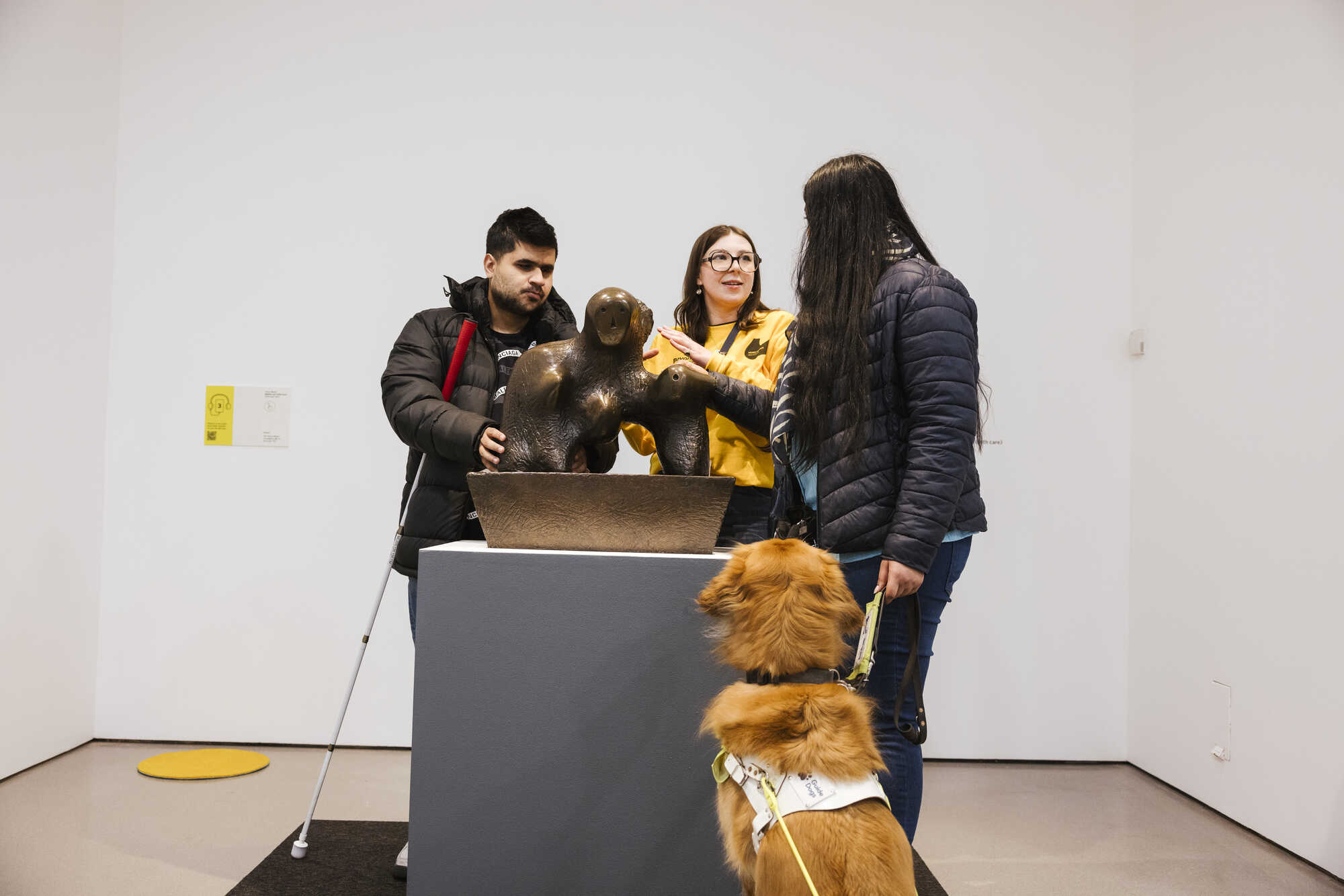
At its core, Beyond the Visual, on view until 19 April at the Henry Moore Institute in Leeds (free access), challenges one of the most entrenched conventions of museum culture: the prohibition against touch. Where galleries typically position the viewer at a safe distance, separated by barriers, vitrines, alarms, or simply the instruction “Do Not Touch”, this exhibition reverses the logic entirely. Visitors are invited — even required — to engage with the works through touch, sound, spatial awareness, temperature, and movement.
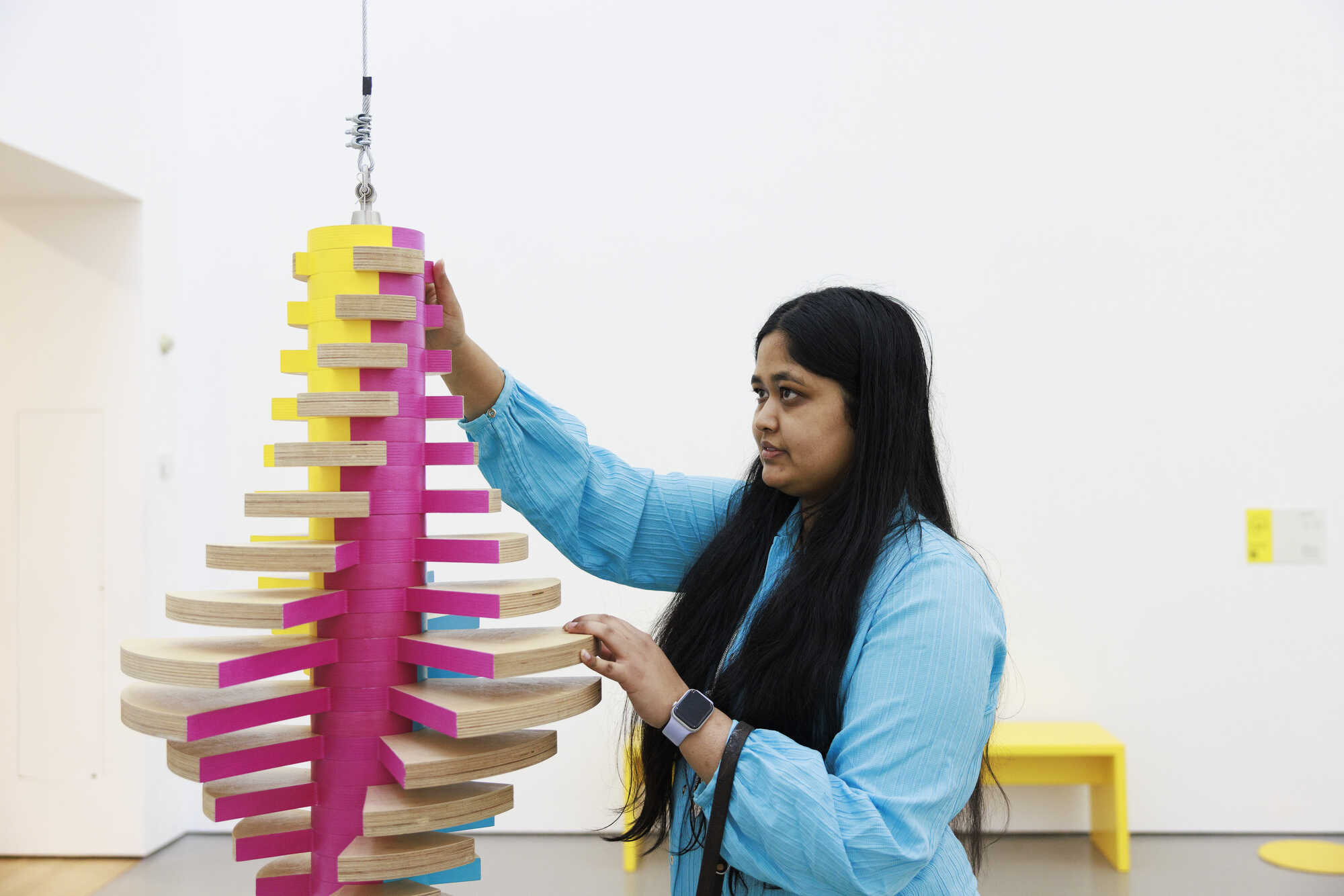
The shift is not symbolic but infrastructural. Carpeted zones signal areas where tactile engagement is encouraged. Audio descriptions are authored in multiple voices and styles, including creative and subjective interpretations. Many works incorporate kinetic elements activated through physical interaction.
Equally important is the curatorial structure: blind and partially blind artists were not merely included but constitute the majority of participants, and they have shaped the exhibition’s conceptual development from the outset, together with Dr Claire O'Dowd, research curator at the Henry Moore Institute, who unfortunately could not join the online session, and her team.
In other words, this is not a visual exhibition made accessible to blind audiences. It is a multisensory exhibition that questions whether vision should ever have been considered sculpture’s primary mode of encounter. It does more than accommodate blindness. It challenges the hierarchy of the senses that has shaped Western Museum culture for centuries.
Hidden Language Under the Table
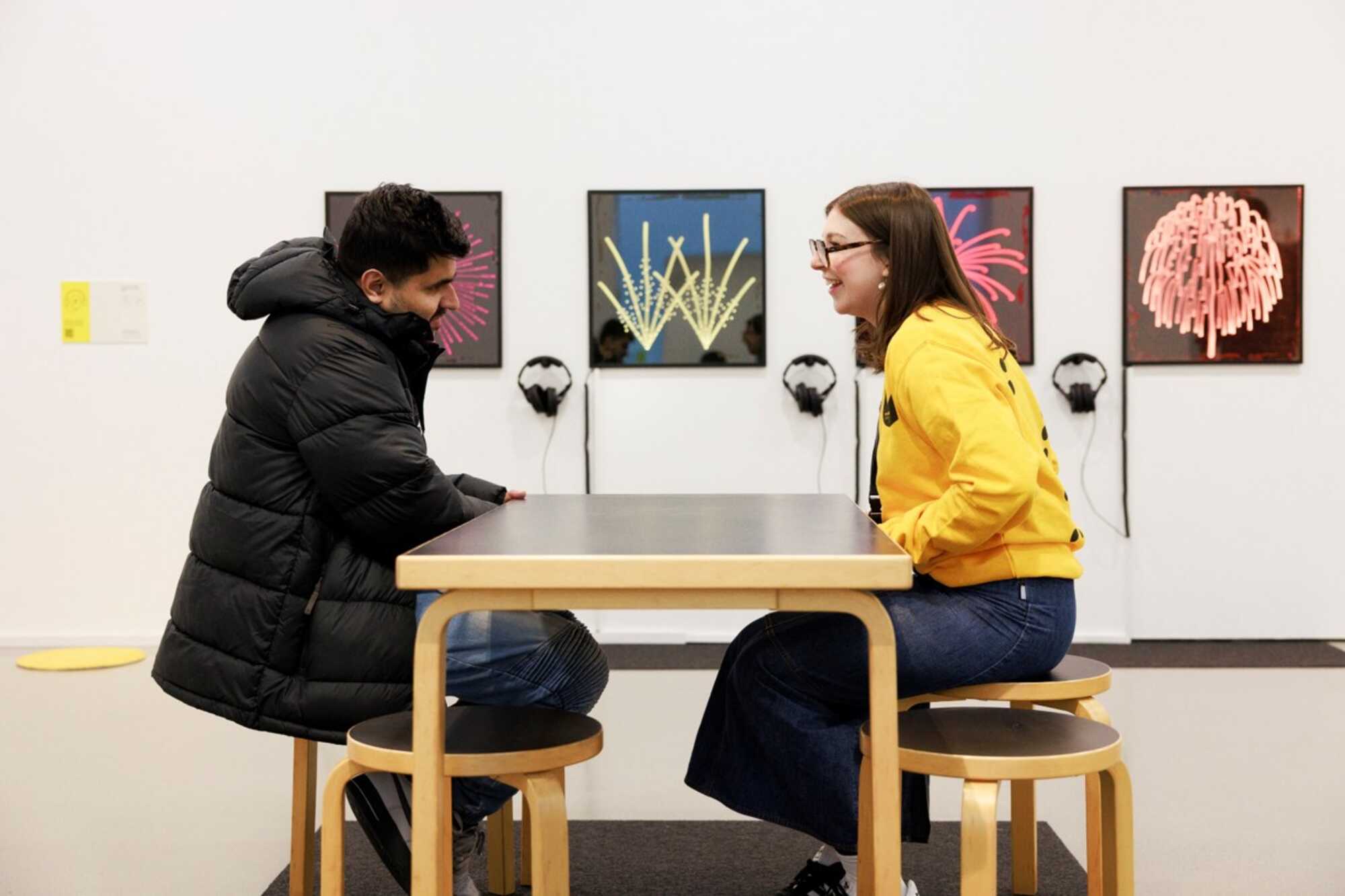
One of the exhibition’s most quietly subversive works is by blind sculptor David Johnson. At first glance, visitors encounter what appears to be a simple table. Yet the work reveals itself only when one reaches beneath the surface. Affixed to the underside are what appear to be discarded pieces of chewing gum. In fact, these forms are cast in silicone and arranged in oversized braille spelling the word inhibition.
The gesture operates on several levels. It invites visitors to break a social taboo — touching what appears to be gum discarded in a public space. It exposes braille, a writing system often hidden from sighted audiences. And it creates an environment of social exchange: the table becomes a place for conversation, discovery, and collective decoding.
Fireworks Without Sight
Another contribution comes from artist and pyrotechnician Collin van Uchelen. His work consists of acrylic panels incised with patterns corresponding to different types of firework explosions.
Van Uchelen, who once had sight but is now completely blind, translates the ephemeral visual spectacle of fireworks into tactile pattern. The panels were created following not only his sight memory but also alternative sensory translations — such as a friend tracing the shape of explosions with fingertips across his back during a live display or offering moving descriptions such as “It’s burning tears”.
Sound, Movement, and the Expanded Field of Sculpture
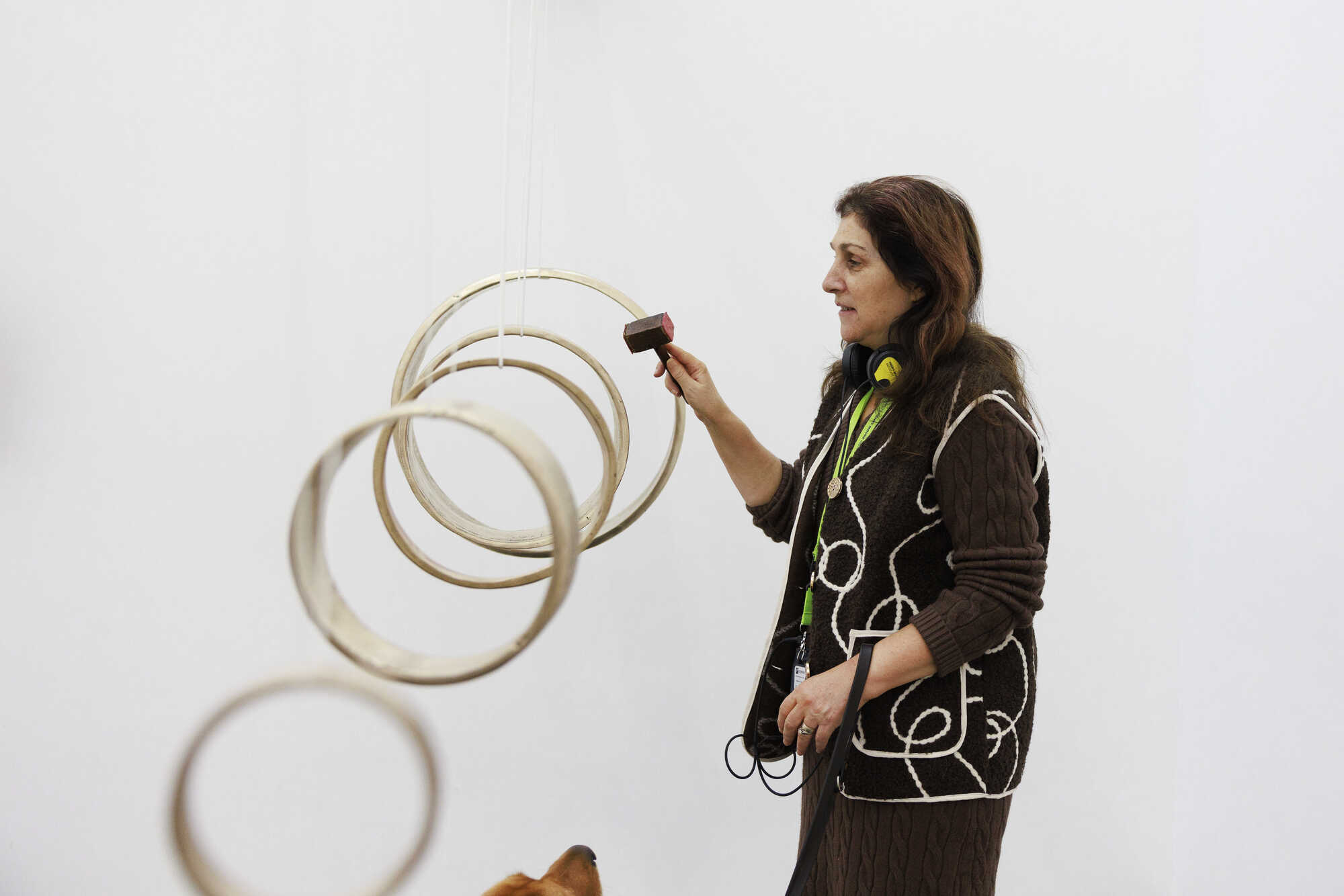
The exhibition extends beyond tactile surfaces into sonic and kinetic environments. Sculptor and co-curator Aaron McPeake presents an installation of suspended bronze rings that function simultaneously as sculptural objects and resonant instruments. When struck, they produce layered tonal fields that define spatial presence through vibration.
Co-curator Ken Wilder contributes a spiral pendulum structure that can be physically set in motion. As it rotates, the tactile form transforms into a visual phenomenon: coloured segments merge into neutral grey when spun at speed, demonstrating the limits of human perception.
These works insist that sculpture is not an object but something experienced through temporal, bodily, and multisensory processes.
Historical Precedents, Current Museum Practices, and Their Limitations
A significant portion of the online discussion placed the exhibition within a longer history of tactile or “sculpture for the blind” initiatives.
Perhaps the most well-known precedents were the series of Sculpture for the Blind exhibitions at Tate Modern in 1976 and 1981. While pioneering in intention, these projects were largely curated by sighted professionals and featured predominantly sighted artists.
Moreover, such exhibitions often operated through segregation. In some cases, only blind visitors were permitted to enter the space, transforming the act of tactile engagement into a spectacle observed by sighted audiences from outside.
Other examples discussed included contemporary practices such as facsimile displays in institutions like the Archaeological Museum of Athens, where visitors are sometimes permitted to touch replicas but only if they are blind. These policies reinforce categorical divisions rather than dismantling them.
Even canonical works explicitly conceived for tactile engagement, such as Constantin Brancusi’s Sculpture for the Blind (1920), are placed behind glass at the Philadelphia Museum of Art.
Wilder pointed to the institutional imperative of preservation. Museums seek to protect works for future generations, yet in doing so they exclude present audiences — particularly those for whom touch is essential.
McPeake added that even when tactile access is permitted, it is frequently mediated through awkward procedures such as mandatory gloves, restrictive guided tours, or standardized audio descriptions that reduce artworks to neutralized visual summaries.
The experience of this new groundbreaking exhibition at the Henry Moore Institute in Leeds — the result of three years of research — showed that when given clear instructions and active docents, audiences follow them and nothing detrimental happens to the artworks.
Aaron McPeake: Material Intelligence and Lived Experience
The Irish artist Aaron McPeake’s path to sculpture was shaped by a gradual transition from full sight to low vision, and he has been registered blind for many years. Originally trained as a theatre lighting designer with full vision, McPeake experienced a gradual transition into low vision, a shift that profoundly reshaped both his perceptual world and his sculptural practice, leading him to explore material, spatial, and sonic forms of knowledge beyond the visual.
His artistic development has also been shaped by long periods spent in Southeast Asia—particularly in Myanmar, Thailand, Laos, and Cambodia—where travel, meditation practices, and encounters with shadow theatre traditions inspired projects such as A Sense of the World: The Blind Traveller and later sound-based sculptural works inspired by bells and gongs.
He teaches at the Chelsea and Camberwell Colleges of Arts, where tactile and process-based approaches form central components of his pedagogy.
McPeake’s artistic work frequently explores sound, resonance, and physical vibration. His curatorial contribution to Beyond the Visual reflects a commitment to embedding access at every stage of decision-making — from exhibition layout to internal communication formats.
For McPeake, access is not a compensatory measure but a generative principle. When institutions adapt to diverse sensory needs, they produce richer artistic environments for everyone.
Ken Wilder: Spatial Theory and Multisensory Architecture
Ken Wilder approaches sculpture through architectural and philosophical inquiry. A professor of aesthetics, he has long investigated how bodies inhabit space and how perception extends beyond vision.
His artistic practice includes architectural interventions, sound installations, and environments designed to heighten sensory awareness. In the exhibition, these concerns manifest in works that test perceptual thresholds and encourage sustained spatial attention.
Together, McPeake and Wilder initiated a multidisciplinary research network involving artists, psychologists, philosophers, disability advocates, and museum professionals. The outcome is collected in the book Beyond the Visual: Multisensory Modes of Beholding Art, which broadens the discussion of multisensory ways of perceiving contemporary art, with a particular emphasis on modes that transcend dependence on sight. It is generously available as a free download from the publisher’s website at UCL Press.
A Specialist Audience, A Collective Inquiry
Perhaps the most consistent theme throughout the discussion was the idea that accessibility benefits all visitors, not only those with disabilities. Larger font sizes improve readability for everyone. Multisensory interpretation deepens aesthetic engagement. Spatial clarity enhances navigation for all bodies.
As McPeake noted, access measures initially designed for one group frequently become universally valuable. The exhibition thus reframes accessibility as a driver of innovation rather than a logistical burden.
What emerges from both the exhibition and the online discussion is a fundamental redefinition of sculptural experience. Touch is not therapeutic supplementation. Sound is not atmospheric enhancement. Spatial awareness is not incidental. These are primary modes of knowing; they are forms of perception that expand rather than replace vision.
By embedding access into every curatorial decision, foregrounding blind artistic authorship, and dismantling the visual dominance of gallery display, Beyond the Visual proposes a radically inclusive model of exhibition-making.
Its significance extends beyond disability discourse. It suggests that museums may have misunderstood their own medium — mistaking sculpture for something to be seen rather than something to be encountered with the whole body.
About the author

Ilaria Specos
An Italian in Germany with a passion for languages, contemporary art, and traveling. I studied Art History in Verona (IT) and Utrecht (NL) and have been working at Sculpture Network since 2014.
Translation
Elka Parveva-Kern
Elka Parveva-Kern supports Sculpture Network since 2024 as a translator - a wonderful opportunity to combine her long-standing interest in languages and art.