Move it! – Things that moved in medieval church interiors

As we know from our experience today, church interiors are quiet and static, and even the congregation moves as slowly and quietly as possible. But this was not always the case. In fact, the concept of a static sacred space is a phenomenon that only emerged in the 19th century. Prior to this, it was common to use various types of movable sculptural elements, even during the celebration of Mass. Johannes Tripps introduced the term “acting sculptures” to describe this phenomenon. Today, this is a scenery that we can hardly imagine anymore – and that is precisely why it is so interesting to us.
Inner and outer movement
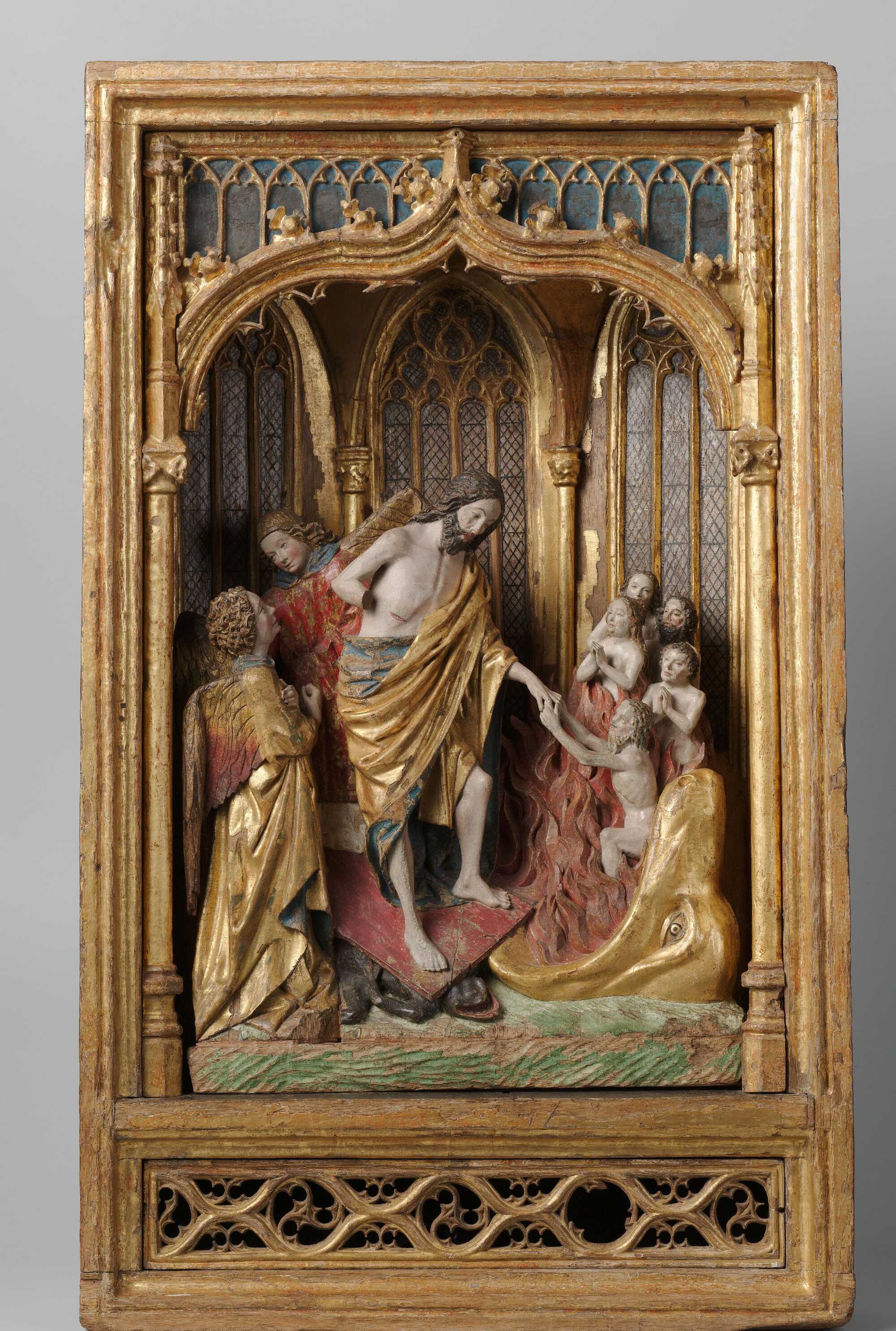
The Middle Ages are often regarded as “dark” and “static”, and medieval sculpture as “block-like” and “stiff”. However, this perception is highly simplistic and generally inaccurate. Illustrating the inner emotion conveyed by the form of sculptures, depictions, and relief scenes was an important task for medieval artists from early on. This was particularly evident in dramatic depictions such as the Descent of Christ into Hell or the Descent of Christ into the Underworld.
In the Rijksmuseum in Amsterdam, there is such a depiction from the first half of the 16th century, in which Christ – after breaking through the gates of hell and defeating the devil – frees Adam and others who were banished to hell but who were actually righteous people from purgatory. Set in a gilded tabernacle, this movement – both inwardly and outwardly – becomes even more apparent. The same is true of many depictions of the enlarged crucifixion scene (Golgotha group), also showing the two thieves crucified beside him.

The Passion narrative of the evangelist Luke (23:39–43) names the “bad thief” Gestas, who mocked Christ on the cross, while the “good thief” Dismas subsequently reprimanded him. These two crucified figures are often depicted in a state of intense agitation, in physically strenuous postures – not only in paintings but also in sculptures.
While devout individuals had to move themselves along the Way of the Cross or publicly staged scenes of Calvary, there also existed portable devices for private devotion at home or while travelling. Portable altars, for example, could be opened and closed like winged altars, transported, and set up wherever desired. Here, the physical movement of the portable altar was combined with the visualisation of inner movement.

However, there were also sculptures in medieval church interiors that actually moved or were moved, such as automata (figures that moved independently after a mechanical impulse), sculptures that triggered sounds, images that were carried around during the liturgy and integrated scenically into the mass, etc.
Medieval sculptures in motion – Praymobil
The major temporary exhibition Medieval Sculptures in Motion – Praymobil at the Suermondt-Ludwig-Museum in Aachen is the first comprehensive museum exhibition dedicated to this subject. The team of curators, consisting of Michael Rief, the man behind the idea and an expert on the Middle Ages, and the renowned art historian Dagmar Preising, focused on medieval wooden sculptures from German-speaking and Dutch-speaking regions in their selection of exhibits. Given that wooden sculptures require very specific conservatory conditions, it is impressive how many original exhibits they were able to bring together.

A palm donkey on wheels with a figure of Christ welcomes the visitor in the foyer of the museum and shows the way to the special exhibition. And it starts with an absolute highlight: an (almost) life-size Saint George with a lance on his horse on wheels from the Netherlands. In fact, it is – as far as can be ascertained – the only one of its kind that has been preserved in such complete condition, even though the metal parts, among other things, date from a later period. But what was the function of this mobile equestrian sculpture? It was obviously intended primarily to be carried in processions in honour of St George, presumably behind a dragon also mounted on wheels, and to reenact the battle between the knight and the monster at fairs and similar events. Unfortunately, the dragon has not been preserved, but an engraving by Pieter Bruegel the Elder shows us such a show fight and proves that wooden sculptures were indeed used as actors to celebrate festive days. Especially in the case of the dragon sculpture, it would have been exciting to know whether it also had a mechanism for breathing fire or emitting steam – or at least a movable wooden flame in its mouth...

Visitors to the exhibition can experience the atmosphere of moving and sounding sculptures for themselves when, immediately after encountering Saint George, they come across an automaton modelled on the original in Middle Franconia. Here, death is depicted with a lion. A skeleton beats a lion on the head at regular intervals, accompanied by a ringing sound. The original is not in working order and may not be taken on loan. This is one of the few situations in which a reproduction can contribute more to the overall impression of an exhibition than the actual original.


Other mechanisms of movement, such as those found on crucifixes (cross with Corpus Christi) or movable figures of Christ (jointed figures), were illustrated either explicitly by the nature of the presentation or by interactive stations. At the latter, visitors themselves could test the mobility by rotating and shifting the figures.
What distinguishes curator Michael Rief's highly accessible and innovative displays of works – here as in other exhibitions – is his courage in employing simple and easily comprehensible methods of visualisation. Thus, two similar depictions of the Pietà are shown side by side, in one of which Christ's body is sitting on Mary's lap, and in the other, Christ is lying on the floor in front of her, creating a “before and after” image. In some places, the directions of movement and modes of action are simply drawn on the display cases with a white acrylic pen – a small gesture with a big impact.


An entire room is dedicated to Child Jesus. During the liturgy, the Christ Child was placed in a manger or crib, seated on a throne, taken from a Mary and Child group or an Anna Selbditt group—or ceremoniously put back in place. In this selection of works, it becomes very clear that wooden sculptures or parts thereof were also actively incorporated into mystical plays at that time.
Particularly impressive are two figures of Mary, each with a hole in the abdomen containing a removable Baby Jesus. However, the infant is depicted not in anatomically accurate form, but rather in a religious-royal form. This iconography of Mary is called Maria gravida (Mary in hope). In most cases, the Christ Child has been lost over time. The exhibition presents at least one complete set.


Near the end of the exhibition, and this was one of my personal highlights, the ascension of Christ is explored. These sculptures were pulled upward through a hole in the church vault, turning as they rose and moving further and further away from the congregation toward the heavens. The elusive act of Christ's ascension was thus made performatively tangible in a theatrical manner. Some of these sculptures were also carved with cloud or spiral shapes on the underside to further enhance the illusion of this heavenward movement. Similarly, Christ's clothing was depicted as if in motion – with flowing robes and mantle hems and cascading fabric. These depictions of Christ's Ascension must have been truly impressive for the witnessing faithful.
The Augustinian Museum in Fribourg in Brisgau also owns an extraordinary specimen, unfortunately not shown in the exhibition, in which the movement up to heaven is even further enhanced by abstraction and ornamentation. So if you ever find yourself visiting Fribourg, we recommend a visit to this museum – and not just because of the ascending Christ.

The exhibition Medieval Sculptures in Motion – Praymobil at the Suermondt-Ludwig-Museum in Aachen will run until 15 March 2026. For those who are unable to visit the exhibition in person, we highly recommend the accompanying catalogue of the same title, published by Michael Imhof Verlag [Link: Medieval Sculptures in Motion – Imhof Verlag].
The original text was written in German by Dr. Iris Haist.
About the author
Iris Haist
Iris Haist holds a doctorate in art history and is an author. Her passion for stone as a material comes from her grandfather, who was a stonemason and had his workshop in the courtyard of their shared home.
Translation

Sybille Hayek
Sybille Hayek is an editor and translator. Since 2022 she has been supporting our team on a voluntary basis with her trained eye for detail and a great love of language.


