Ken’ichiro Taniguchi: Hecomi Study #55 Museum Boijmans van Beuningen under renovation

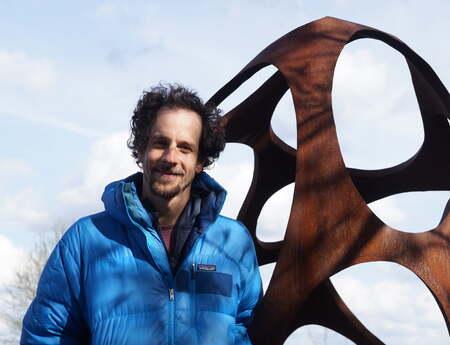
Last year Ken’ichiro Taniguchi – a Japanese artist based in Sapporo and Berlin – was given permission to enter the Museum Boijmans Van Beuningen while it was undergoing renovation. There he collected shapes found in several exhibition rooms of the building.
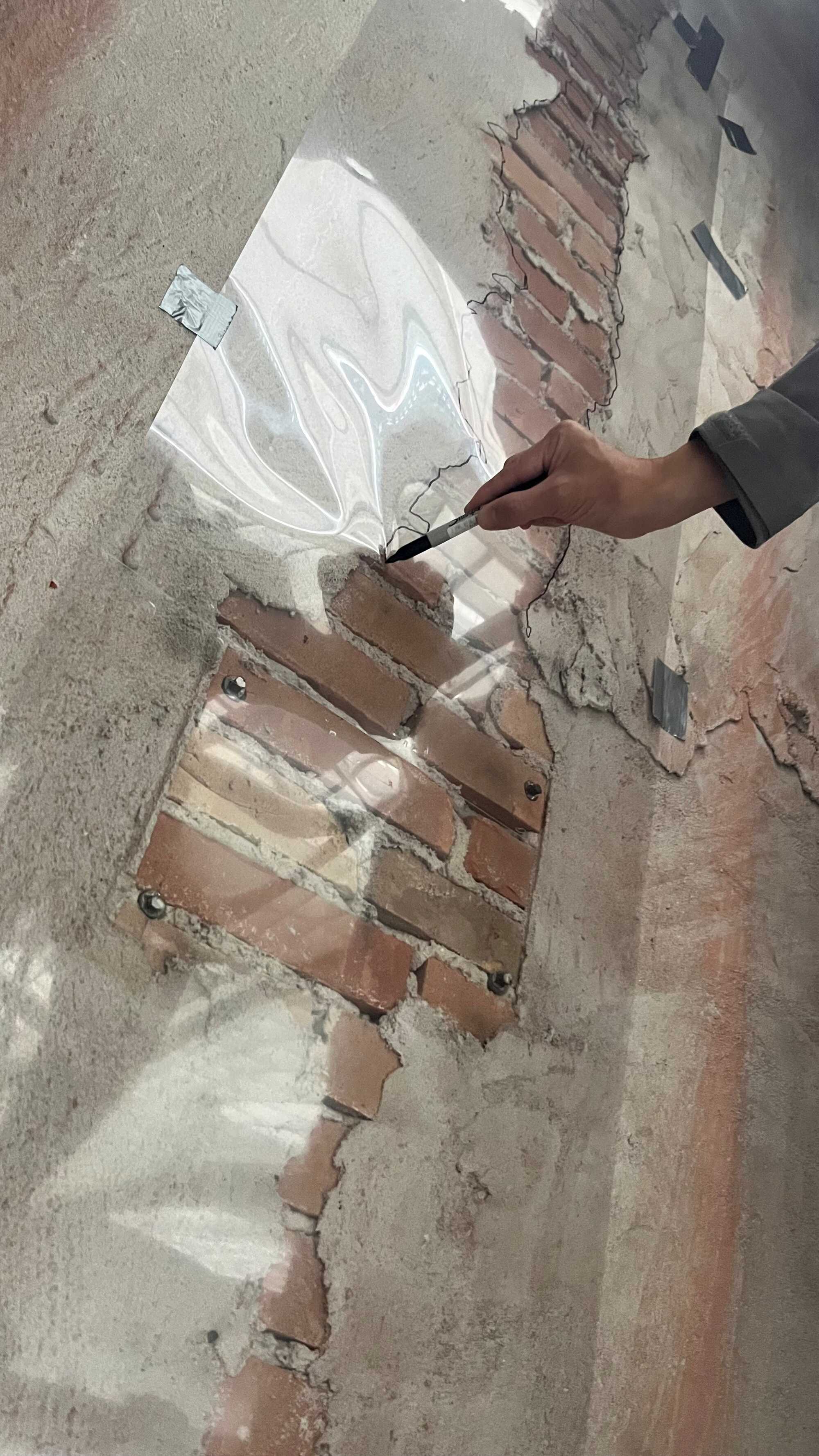
In Taniguchi's practice the shapes are called “Hecomi”: cracks, fissures, and broken or damaged spots that natural forces have created on man-made surfaces like roads and walls. For the upcoming exhibition at Phoebus Gallery, Taniguchi presents a group of sculptures based on approximately 70 of these indentation shapes.
Almost twenty years ago I gave an introductory talk on Taniguchi’s work in Phoebus Rotterdam. His objects by then were quite small, and his technique reminded me of origami: folding individual parts of a shape and assembling them through little screws.
In due time he started working on a larger scale and was developing complete installations and mobiles. This autumn Ken returns to Phoebus Rotterdam with an extensive exhibition. And I was able to ask him some questions, well in advance of the exhibition.
Hecomi Study
What does the word “Hecomi” exactly mean?
The Japanese verb “hekomu” describes the physical indentation of an object's surface, as well as the feeling of being emotionally depressed. Since 2000, I have used cracks, fissures, and damage caused by natural forces on roads, walls, and other man-made surfaces as motifs in my work. I refer to these traces as “hecomi”. Although hecomi are often perceived negatively as signs of age or dirt, isolating their pure forms through visual representation reveals a wide range of appealing qualities, including originality, charm, strength, and sadness. I have collected around 600 examples of hecomi that I find particularly interesting from fifty countries around the world and archived them as a collection of stock shapes. It is important to note that this is not a commonly used artistic technique in Japan. Rather, it is an approach that I, Taniguchi, have discovered and developed independently. Japanese artists do not generally use a technique called hecomi; it is simply the name I have given to my own practice, which I call “Hecomi Study”.
What is the philosophical core of Hecomi?
They are usually seen as ugly signs of decay, but as an artist, by extracting their pure forms, you can reveal unexpected qualities – strength, fragility, sadness, and quiet beauty. It's often described as finding the voice of the boundary between humans and nature. As a Japanese person, I may have an unconscious appreciation of the spirit of Wabi-Sabi. (The Japanese aesthetic and worldview centred on finding beauty in imperfection, impermanence, and incompleteness, EB).

Installations and mobiles
Nowadays you can discover complete installations and life-size mobiles made by Taniguchi in collections throughout the world. The hecomi that were found in Museum Boijmans are a good example.
So, why did you make this change to work on a larger scale?
I feel that the appeal of small, compact works and the power that comes from the sense of scale in larger works are two different things, and in due time I wanted to explore both. For me, it has always felt natural to pursue works with various ranges of scales.

Museum Boijmans Van Beuningen under renovation
The main museum building has been closed since 2019 for a major renovation that will ultimately take around ten years. The final design was presented on 30 October 2025, and Rotterdam City Council approved the design and implementation budget some months later, clearing the way for construction to begin in 2026 by Mecanoo architects. The renovation restores the historic wings by the museum's original architects – Ad van der Steur (1935 building) and A.J. van Bodon – while the 1991 Robbrecht & Daem extension and the Van Beuningen-De Vrieze pavilion will be demolished. Planned is an enlarged entrance, improved routing, a passage connecting the city to the Museumpark, a new belvedère on the south side with a logistics centre beneath it, and restoration of the Hannema Gallery. Total investment is around €223 million. While the main building is closed, the collection remains accessible next door in the spectacular Depot (opened 2021, designed by MVRDV), which has kept the museum visible in the Museumpark during the renovation. The renovated museum is scheduled to open mid-2029.
Under the name “Travelling Exhibitions” Museum Boijmans Van Beuningen organises a programme of travelling exhibitions, with a selection of works drawn from the museum’s diverse collection. It offers high-quality exhibitions centred on a number of the museum’s core collections, such as the Seventeenth Century, Classical Moderns, Surrealism, Design, decorative arts, modern movements and works on paper. Exhibitions and loans were organised in MUDEC, Milan, Metropolitan Art Museum Tokio, National Museum of Osaka and other places.
How was it to work in a museum under reconstruction?
In September 2024, I spent one week tracing the shapes of hecomi, and in May 2026, I spent another three days working on the fitting of hecomi. I immersed myself in the quietness of the unseen, backstage areas of the museum – places that one would normally never have the opportunity to see. I felt fortunate to be able to spend time confronting each hecomi with such concentration. It also gave me time to imagine how each room had been used in the past and what kinds of artworks had once been displayed there.
Did you find there in Boijmans special cracks that you couldn’t find anywhere else?
Of course. In the special circumstances of a museum undergoing renovation, I encountered many hecomi that were quite different from those found in everyday environments. The architectural materials used are different, and each room has been constructed and finished specifically for the purpose of displaying artworks.

Working in the Netherlands
Can you tell me what you liked about working in the Netherlands?
Thanks to the gallery I work with, I have had the opportunity to witness and participate in many extraordinary situations. The renovation of the Museum Boijmans Van Beuningen was one of them. Other experiences that had a strong impact on me included collecting indentations at an archaeological excavation site dating back to around the 11th century and collecting indentations at a factory that has since become a UNESCO World Heritage Site. I have also been struck by the flexibility of society and its generosity in allowing an individual artist to have access to and experience such unusual places and situations.
Do you have any interesting plans, or assignments for the near future?
I would like to continue taking on new challenges – not only through the development of individual works, but also through combinations of multiple works, different approaches to installation, and the relationship between the works and their exhibition spaces. In recent years, I have increasingly been making installations outdoors, in places such as forests and along bodies of water. And I would like to continue developing works that incorporate elements such as wind, light, and weather.
Hecomi map
Together with the exhibition Phoebus Rotterdam will edit a “Hecomi Map”. The project manager is Ayako Taniguchi, all in cooperation with Phoebus Rotterdam.
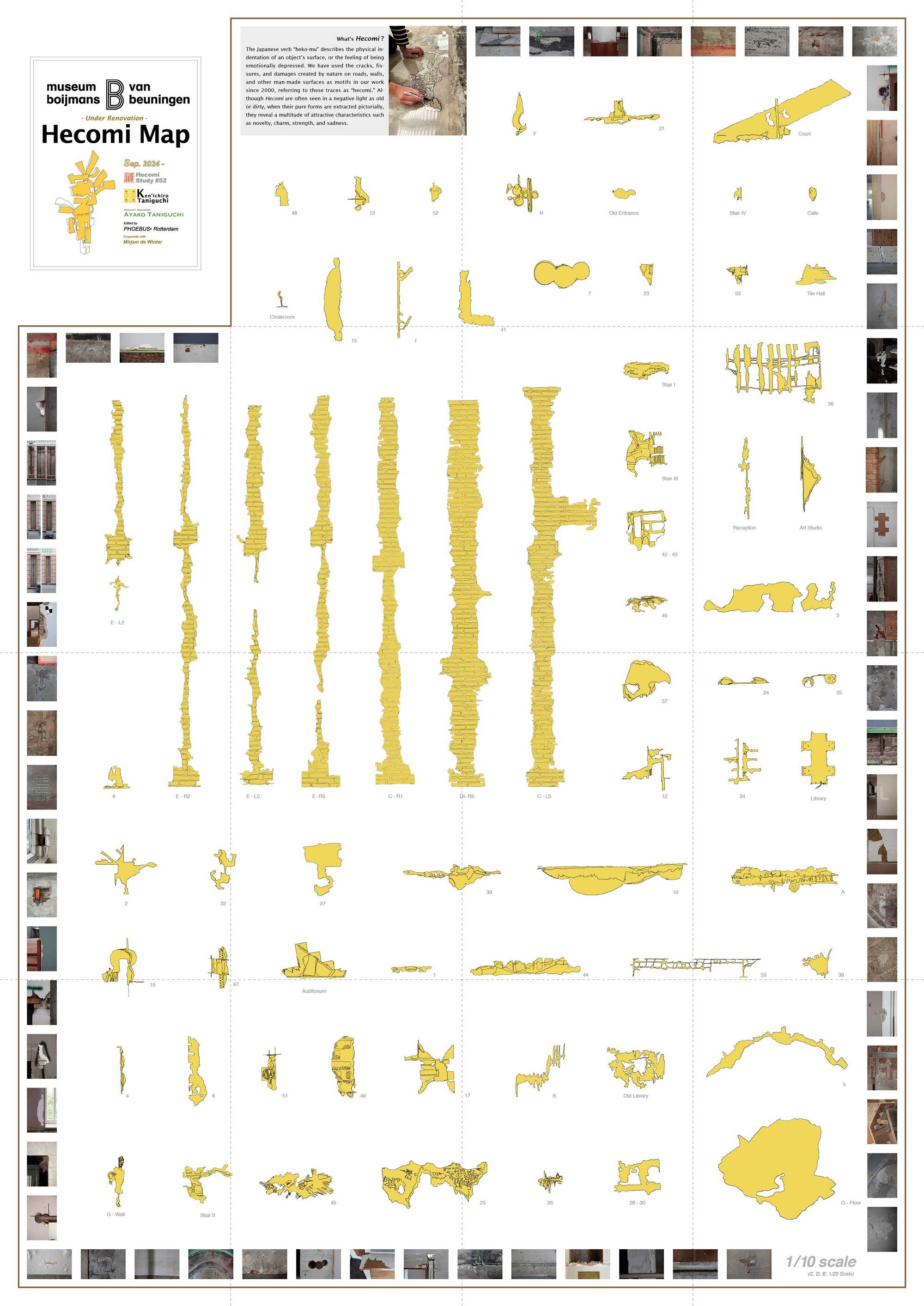
Ken’ichiro Taniguchi: Hecomi Study #55
Phoebus Rotterdam 8 November – 20 December 2026
www.phoebus.nl
This article was written in English by Etienne Boileau.
About the author
Etienne Boileau
Etienne Boileau is a Rotterdam based journalist and writer.
Translation

Sybille Hayek
Sybille Hayek is an editor and translator. Since 2022 she has been supporting our team on a voluntary basis with her trained eye for detail and a great love of language.