David of the Alps

“David” is a fine figure of a man carved from stone. Smart, elegant, holding himself with a casual air and sporting a six-pack. Michelangelo di Lodovico Buonarroti Simoni carved the ideal man out of Carrara marble. 522 years later, the same (though not the very same) man is standing in the municipality of Klosters in the Swiss canton of Grisons.
Klosters
The history of the village dates back to 1222. Monks from Churwalden established a provostry there. In the 1950s, the village became a meeting place for celebrities: Hollywood on the Rocks! For over 40 years, King Charles III has been spending his winter break here. Why? Same procedure as every year. True enough! On the other hand, this mountain village in the Grisons is now far removed from the usual celebrity hustle and bustle. Never mind! Klosters is currently home to the “sexiest man” in European art history. “David” is sexy, beautiful and clever, as sharp-witted in the present as he is fit for the future. Every fibre of his musculature is perfectly toned, and naturally he is endowed with an unrivalled intellectual elegance – a man who does not necessarily look like someone who would ever have to earn a living from regular work. Right now, in this age of self-optimisation and insta-obsession, he just looks like the perfect model in his classic contrapost pose, as he has done for centuries. The David in Klosters is not “the David”. It is a replicate. At first glance, this is not out of the ordinary. “David” has many twins. The sculpture is the most copied figure in the world. In Florence, a doppelgänger can be found in the Piazza della Signoria, and a bronze replica is located in the Piazzale Michelangelo. In addition, there are millions of souvenir replicas in the form of small plaster sculptures, printed kitchen aprons, T-shirts or underwear. That does not detract from the original.
Marble from Michelangelo’s Quarry
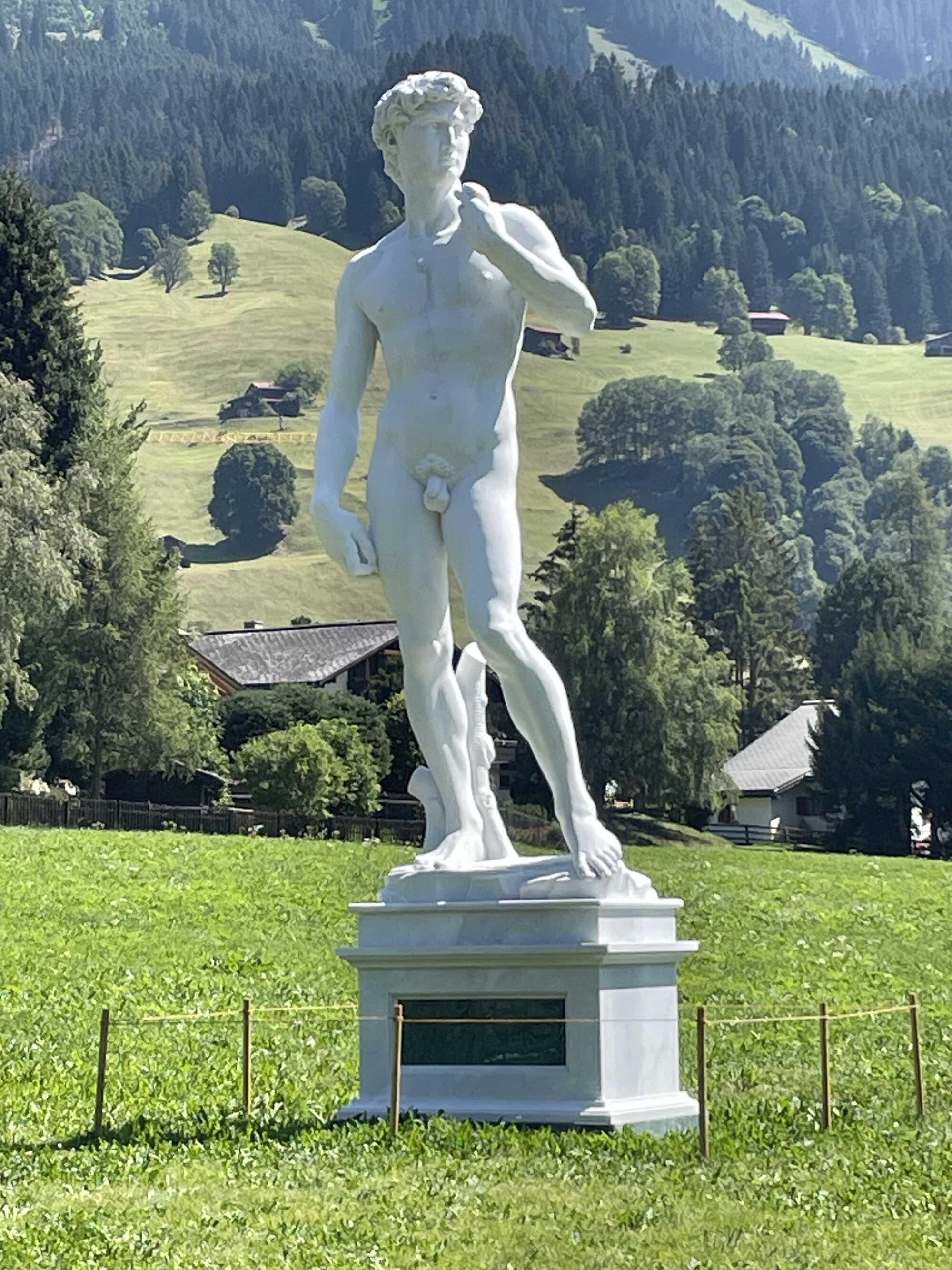
This duplicate is not, however, intended to be just another duplicate. The sculpture, which stands over five metres tall and weighs over 17 tonnes with its plinth, was crafted from pure white marble – known as “Marmo Bianco Michelangelo” – sourced from the Polvaccio quarries situated above Carrara. The marble used, as stated by the project’s initiator, the Swiss painter and sculptor Christian Bolt, comes from the same quarry as the block from which Michelangelo carved his “David”. Since 2014, Bolt has been professor of sculpture at the “Accademia Delle Arti Del Disegno” in Florence, and he discovered the replica of the David some time ago at the sculpture studio “Cave Michelangelo” in Carrara. This copy was not created as a commissioned piece, but out of passion by Franco Barattini, the company’s owner. Experts digitally captured the data from the original there. CAD-controlled multi-axis robots then milled a rough-cut piece from the block. The hands, eye sockets, nostrils, earlobes, and other areas were manually refined, and the entire surface was reworked. Michelangelo himself had at most a handful of assistants at his disposal in the 16th century when he created the first colossal statue since antiquity.
Determination Not Triumph
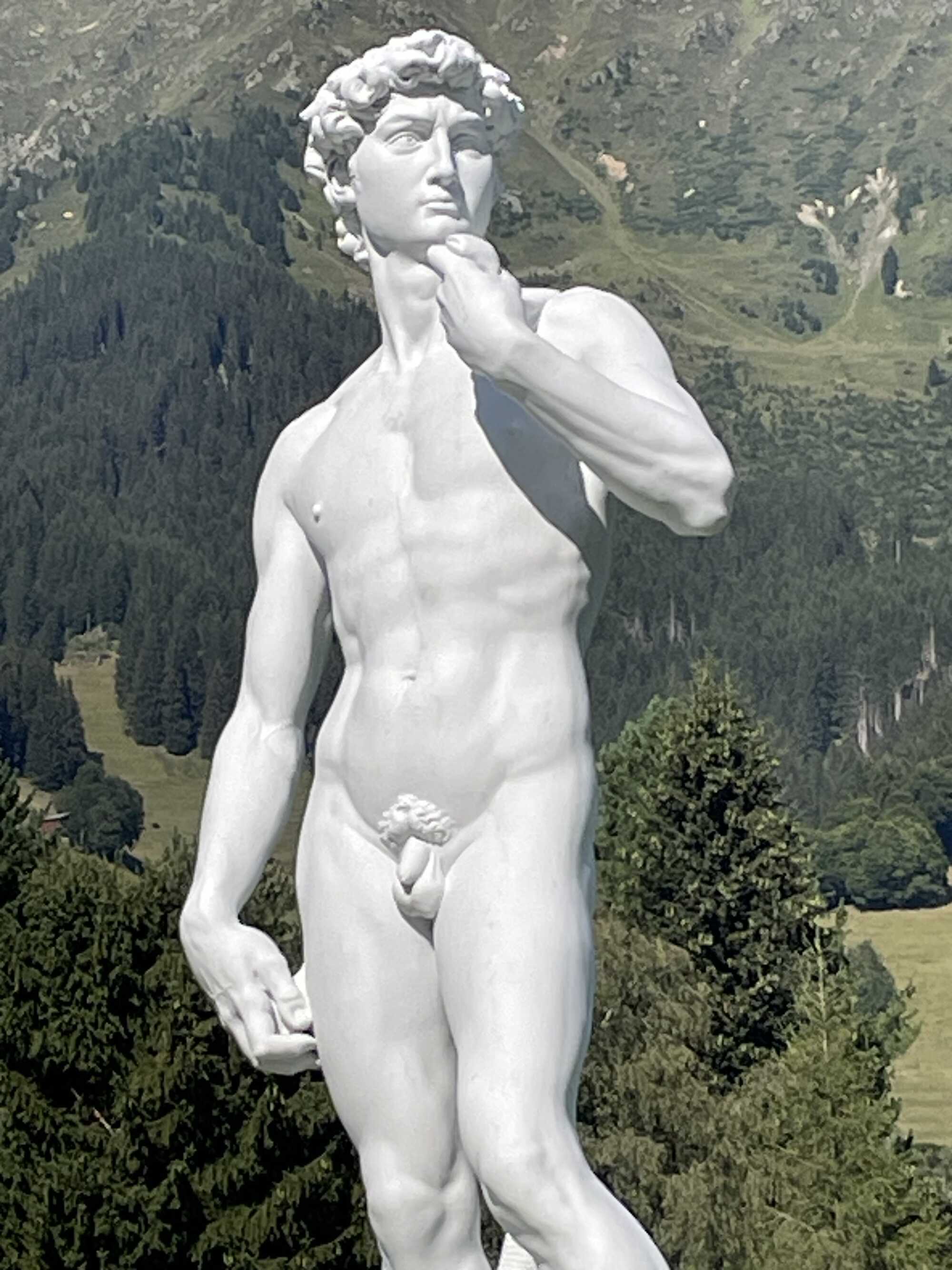
Michelangelo, however, does not portray David's triumph, but rather the moment when he decides to fight Goliath. With his left hand raised, he places the sling of the catapult over his shoulder, whilst in his right hand he holds a stone. For almost three years he worked behind a wooden shack on his piece of art, which hardly anyone saw during that time. He cleverly staged the rescue of the block – which had previously been abandoned – as a stroke of genius. Once completed, a committee of 30 influential Florentine citizens (including Leonardo da Vinci and Sandro Botticelli) deliberated on the most suitable location for the sculpture. They chose the square in front of the entrance to the Palazzo Vecchio. There, Michelangelo’s “David” replaced Donatello’s bronze sculpture “Judith and Holofernes”. By then, fortunately, Donatello had been dead for almost 40 years. “David” remained in that same spot until the sculpture was moved to the “Galleria dell’Accademia di Firenze” in 1873.
David and Artificial Intelligence
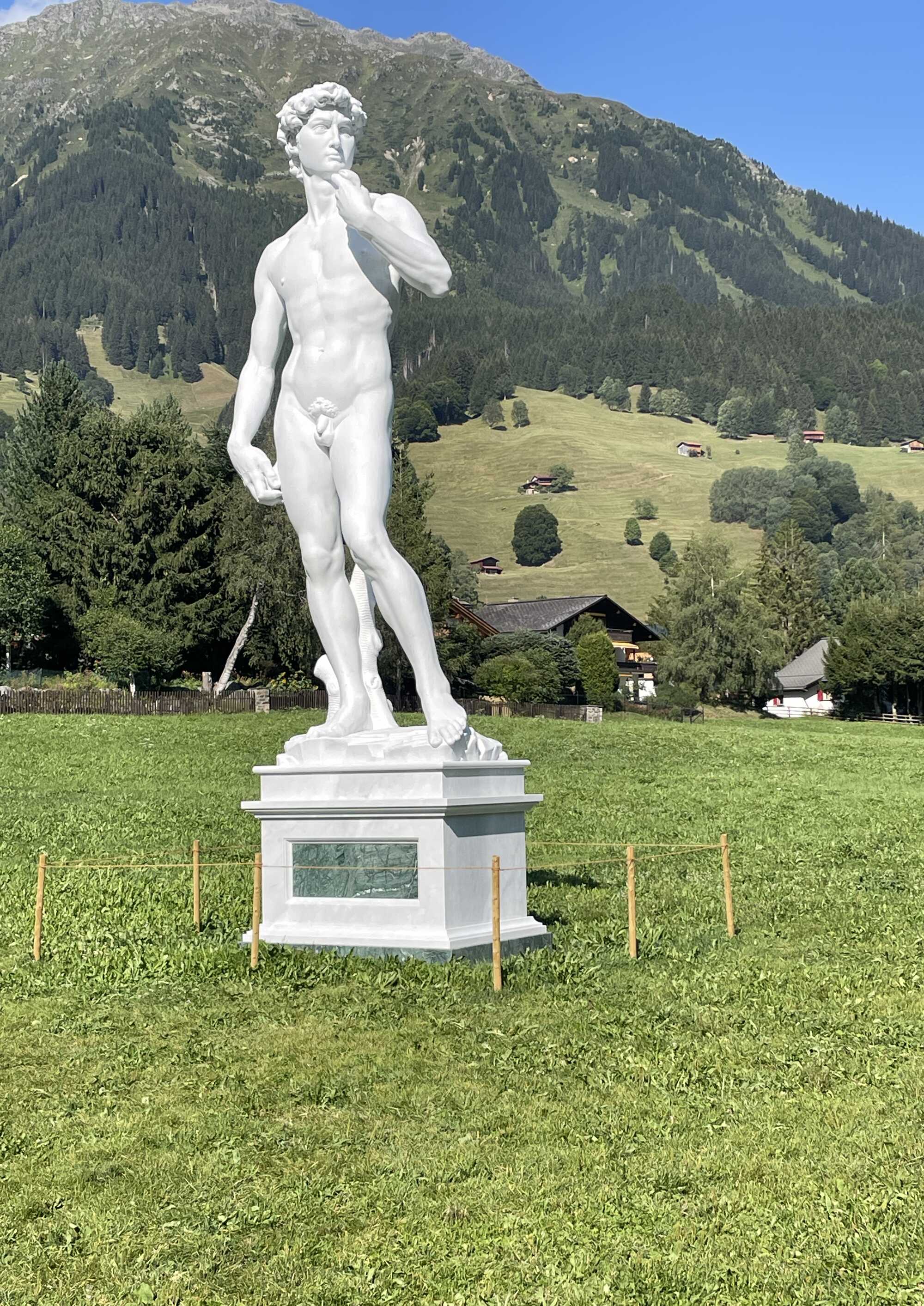
Christian Bolt does not want the Alpine David to be seen as a mere reproduction. For him, the quality of the stone and the scale of the sculpture are truly stunning: the marble is pure white and of the highest quality, the replica is formally perfect and meticulously crafted. Bolt's initiative aims to put the Renaissance icon within a new, Alpine context. He is interested in what happens to an icon when it is torn from its familiar setting; on the one hand. On the other hand, the idea of David’s new doppelgänger in the Swiss Alps does not seem that far-fetched. After all, in the Bible, David is a shepherd boy – in other words, a counterpart to “Heidi’s” goatherd Geißenpeter; that’s one aspect. Another aspect is that Michelangelo’s “David” embodies an ideal image of humanity that remains relevant to this day. Humans live with self-confidence and self-determination. Within their perfect bodies resides (hopefully!) a wise mind.
Not a bad idea, at a time when artificial intelligence (AI) is increasingly becoming a threat to the very human creativity and authorship that Michelangelo so brilliantly embodied. Defending those values could prove to be a task comparable to David’s battle against Goliath. Ultimately, there is one further aspect. In Florence, David was a symbolic figure of civic independence. He stood for the self-assured and resilient Republic of Florence that had driven the ruling Medici family out of the city in 1494. Perhaps that is why Michelangelo’s “David” feels at home in Switzerland: a hero like William Tell – only in a sexy version.
“David” will be on display in Klosters until 31 October 2026.
Willy Hafner originally wrote this article in German.
About the author

Willy Hafner
Willy Hafner is a Munich based art historian who helped organize the first and second Sculpture Network Lab in 2019. Since then he has been reporting for us on exciting sculpture projects in Germany and beyond. He is also a member of the Patronage Committee of the Centro Internazionale di Scultura and helps emphasize the economic and cultural significance of the project.
Translation

Sybille Hayek
Sybille Hayek is an editor and translator. Since 2022 she has been supporting our team on a voluntary basis with her trained eye for detail and a great love of language.