An evening in Berlin that will stay with you – Visions of Art in Architecture at the Altglienicke art foundry

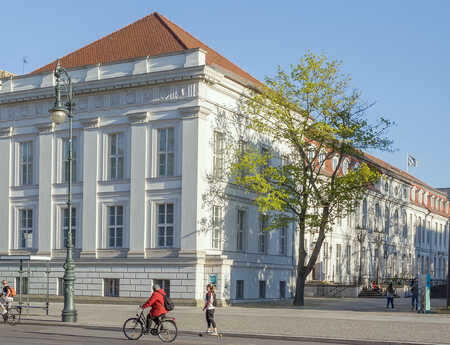
In collaboration with the Centre Pompidou in Paris, the Neue Nationalgalerie in Berlin organised the first major Brancusi retrospective in Germany in over fifty years, opening on 19 March 2026. The following evening, just a few kilometres away, Anke Schirlitz, owner of the Altglienicke art foundry, and sculptor, architect and designer Hans Heinze hosted Visions of Art in Architecture, an immersive exhibition. More than 400 guests filled the art foundry, enthusiastically immersing themselves in the world of sculpture.
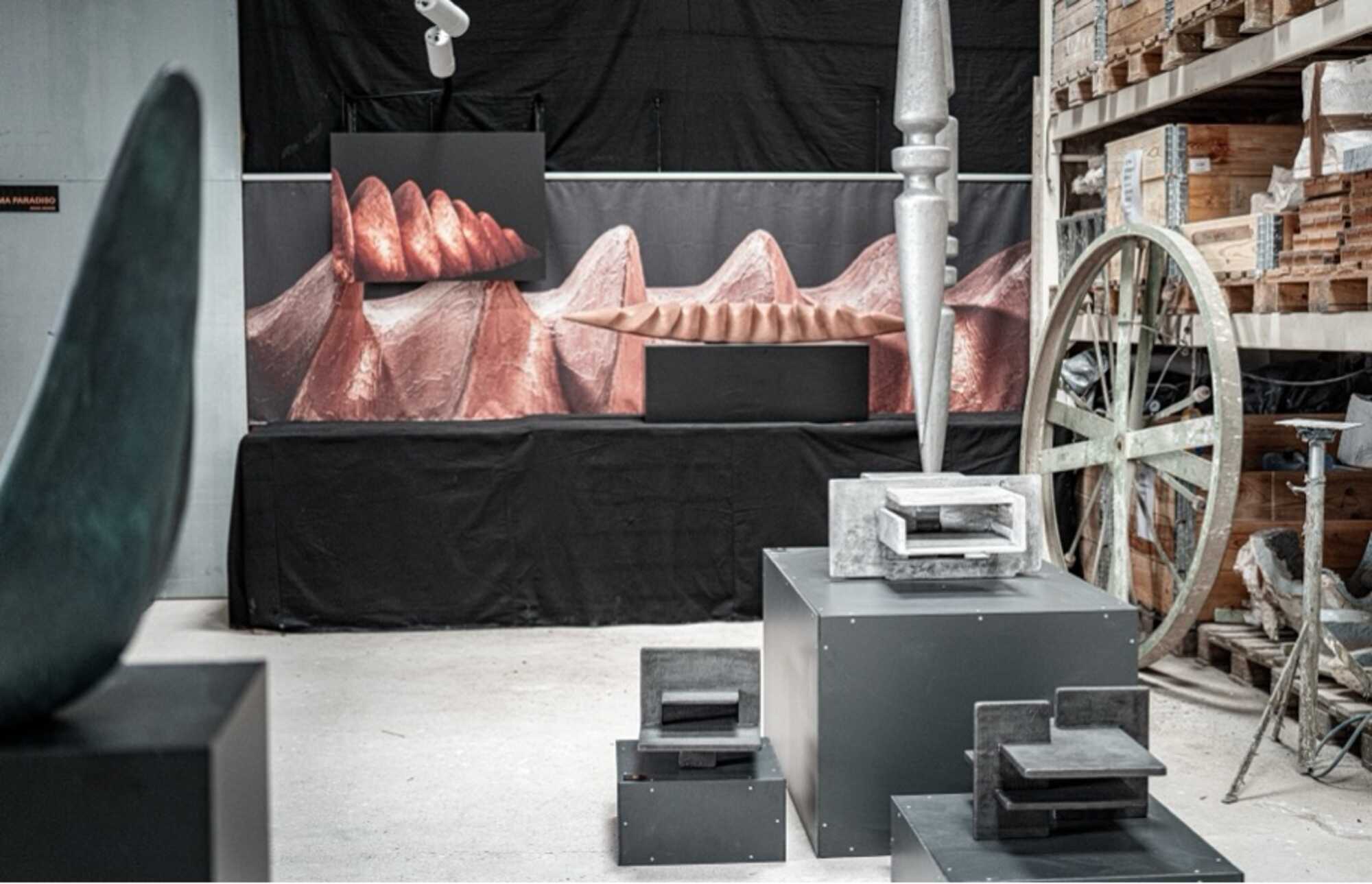
The workrooms had been transformed into themed spaces, each retaining its own identity: the chaser workshop, the patination room, the casting room and the moulding shop. The walls, bearing the marks of daily wear and tear, the tools on the shelves and the trolley suspended from the industrial ceiling were among the first exhibits of the evening. Gernot Böhme, a philosopher whose thinking has had a lasting influence on the discourse surrounding architecture, sculpture and space, calls this an ‘atmosphere’. It is the intermediate realm between the object and the perceiving body. This atmosphere does not arise solely from the object or from the viewer, but from the shared space.
Reflections on the nature of form
This weekend, Berlin reflected on sculpture and on what it means to create something out of raw material – stone, bronze, clay – that transcends the original material. Constantin Brancusi sought the essence of form; the core of a sculpture once all randomness had been removed. When he saw the Manhattan skyline in 1926, he exclaimed: “That’s my studio!” It was a defining moment. A sculpture is like a building on a smaller scale, and a building is like a sculpture on a larger scale. The boundary between the two is fluid.
After visiting Brancusi in Paris in 1933, Barbara Hepworth further developed this concept, moving away from essential abstraction and towards the principle of relationships. To her, a sculpture was never an isolated object. She sought to create a triad of sculpture, architecture and nature, installing her works outdoors to enable them to interact with their surroundings. A sculpture asserts its presence through connection, not isolation.
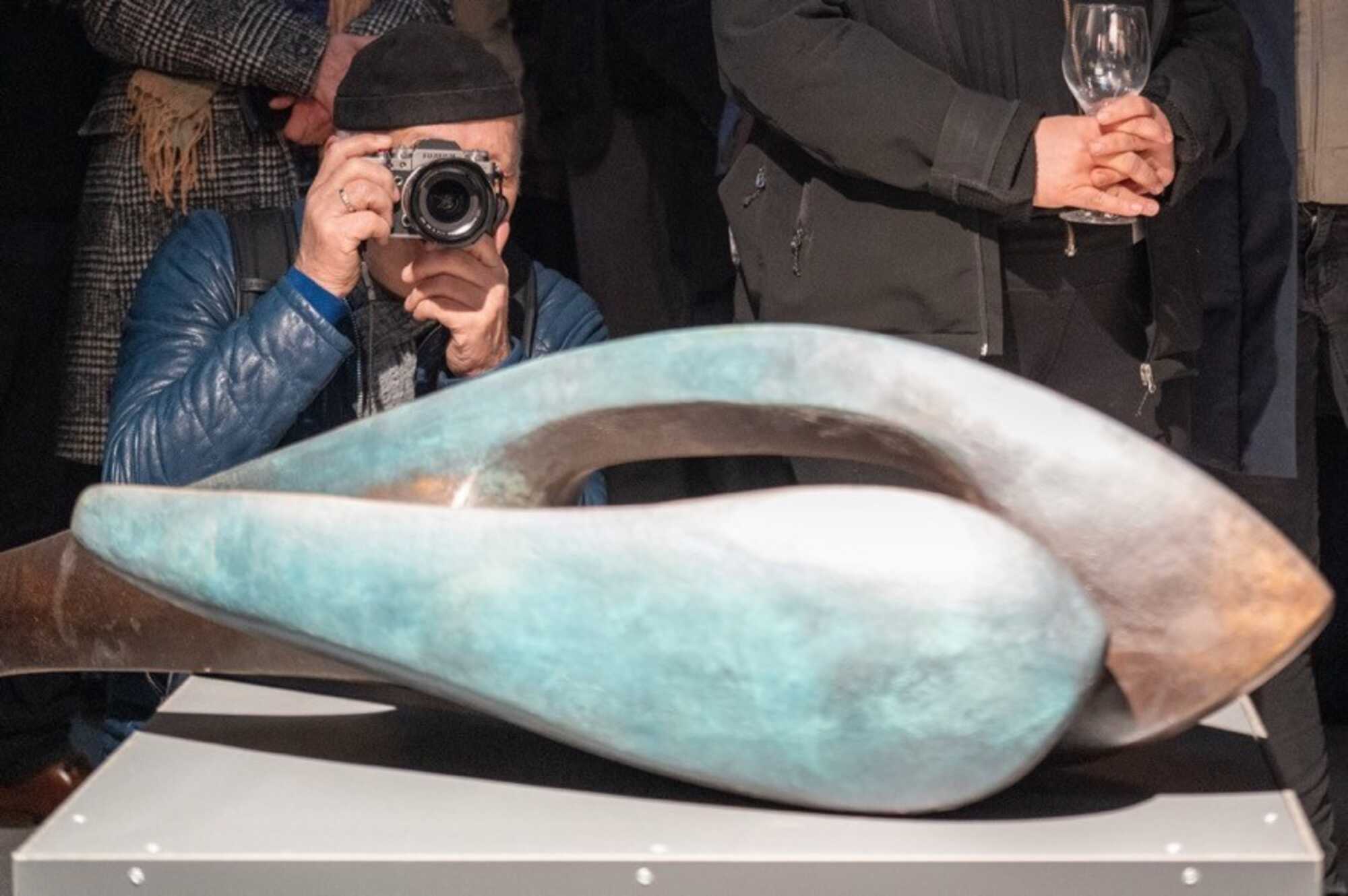
Hans Heinze continues this approach from the perspective of a sensory practice. For him, the tactile process – the coolness of the clay, feeling out the contours and later touching the bronze surface – brings about insight. It is not the idea that takes shape, but rather the form that finds its true self through physical labour. “A surface is not a shell, it is the compression of time and action”, he says. This statement aligns closely with Böhme’s concept of atmosphere and Hepworth’s approach to materials.
In Heinze’s work, Hepworth’s triad of sculpture, architecture and nature becomes a quadrinity of art, architecture, nature and design. As an architect, Heinze has spent almost thirty years designing buildings in their entirety taking into consideration the surrounding landscape, the visual axes, the light and the interior materials and finishes. What takes shape on a large scale as a built space is condensed on a small scale into a cast form. This artistic strategy takes responsibility for the atmosphere of the whole, including the spaces where people live, breathe and think. And within that, the sculpture.
The exhibition architecture
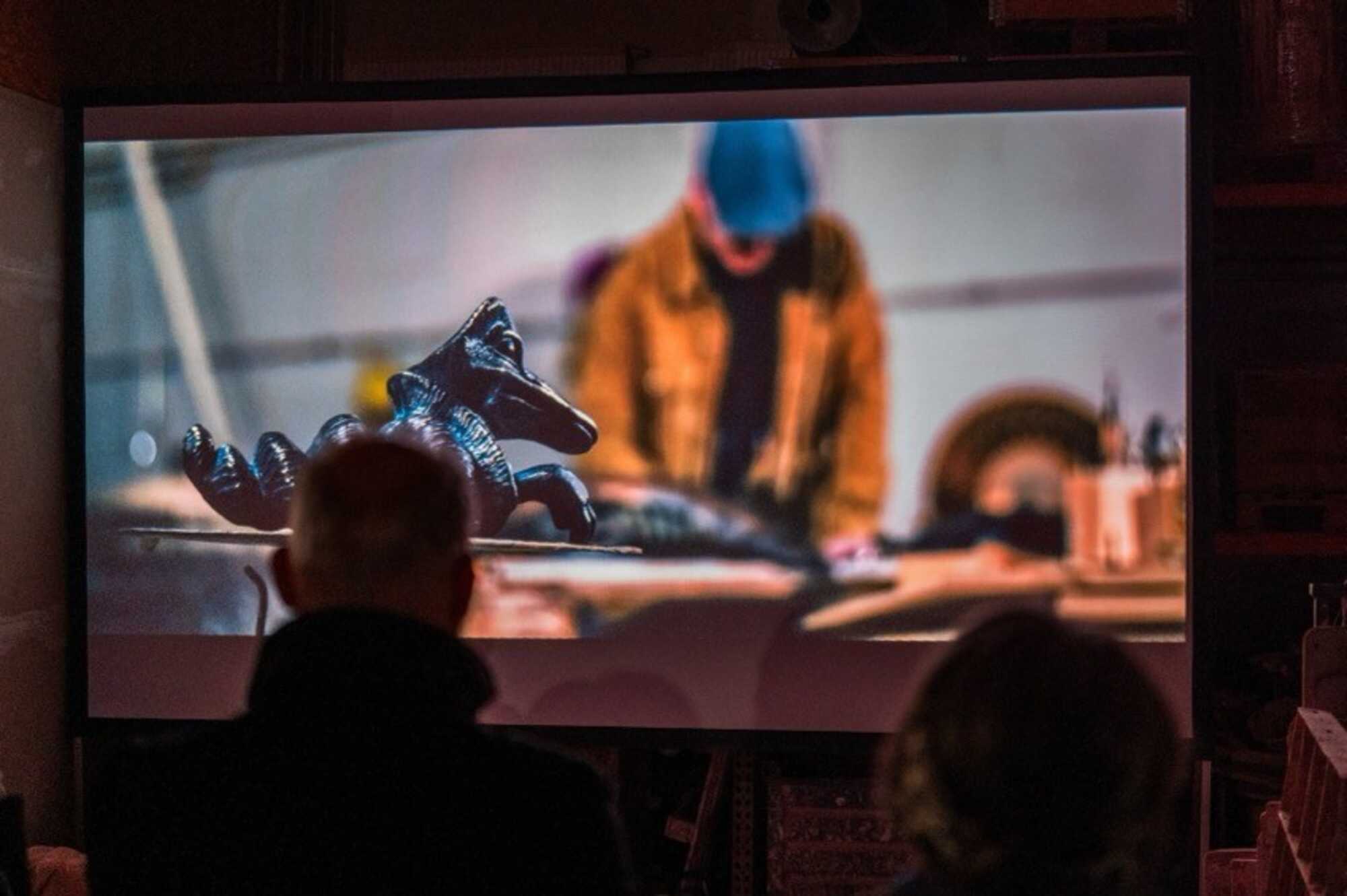
Spanning more than 600 square metres, what unfolded was not just an exhibition, but a full-scale event. It was meticulously organised into eight themed rooms, each with its own scenography. Downstairs in the Atelier, the creative process was laid bare through displays of drawings, maquettes, rough-cut blanks and finished pieces with patina. The Human Beauty room celebrated the human body with bronzes and hybrid artworks. Meanwhile, the Paralleluniversum invited visitors to marvel at the humorous animal sculptures on display. The impressive Pendulum Gravity No. 1 is a bronze sculpture suspended directly above the cauldron’s opening. Illuminated from below with a reddish-orange glow, it appears as if it is still glowing and not yet part of this world. Cinema Paradiso screened art films that artistically captured the creative process behind Heinze’s sculptures.
Housed above the foundry, the gallery is a treasure trove, displaying sixteen bronze sculptures on white pedestals. Designed to impress, this is the most beautiful room, showcasing a variety of pieces that demonstrate fine craftsmanship, exquisite finishes and beautiful patinas. Adjacent to this is the Kabinett der Handschmeichler (engl. Cabinet of Hand Flatterers), which features ten small bronze pieces set on velvet and designed specifically to be touched. “Touch is not a taboo, but an extension of perception”, says Heinze. You could see visitors hesitantly reaching out, pausing, then touching after all – and smiling.
Two treasures
At the heart of the exhibition were two pieces that Heinze describes as his treasures. In the foundry below, we see Die Möglichkeit einer Entfaltung (engl. Opportunity for Development), featuring a head with two hands behind it offering protection. This artwork was created in memory of the artist’s late brother whom Heinze describes as having a true artist’s soul. Positioning the head in front of the casting furnace, where transient matter is transformed into something enduring, is no coincidence. It is a dignified act of mourning.
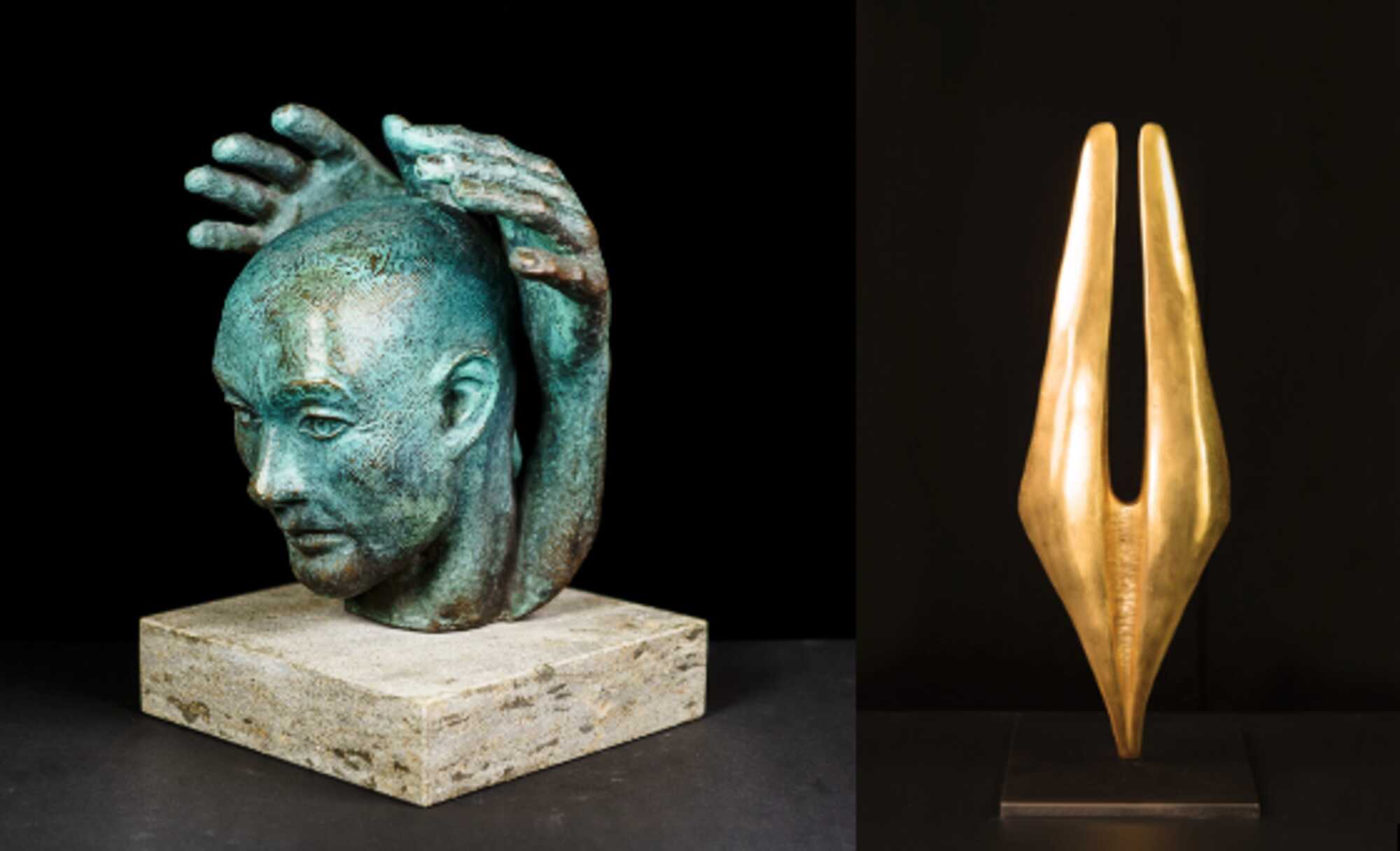
In the upstairs gallery, Ode an die Freude (engl. Ode to Joy) – a golden, upward-opening, fork-like sculpture reminiscent of Brancusi’s ascending forms – sits on a black pedestal against a black wall. Like a cry, it soars into the room – an aspiration in bronze.
These two treasures formed the duality that underpinned the entire exhibition: grief and jubilation, remembrance and new beginnings, reflection and radiance. From mourning to joy. From fire to form.
Vision as a collective endeavour
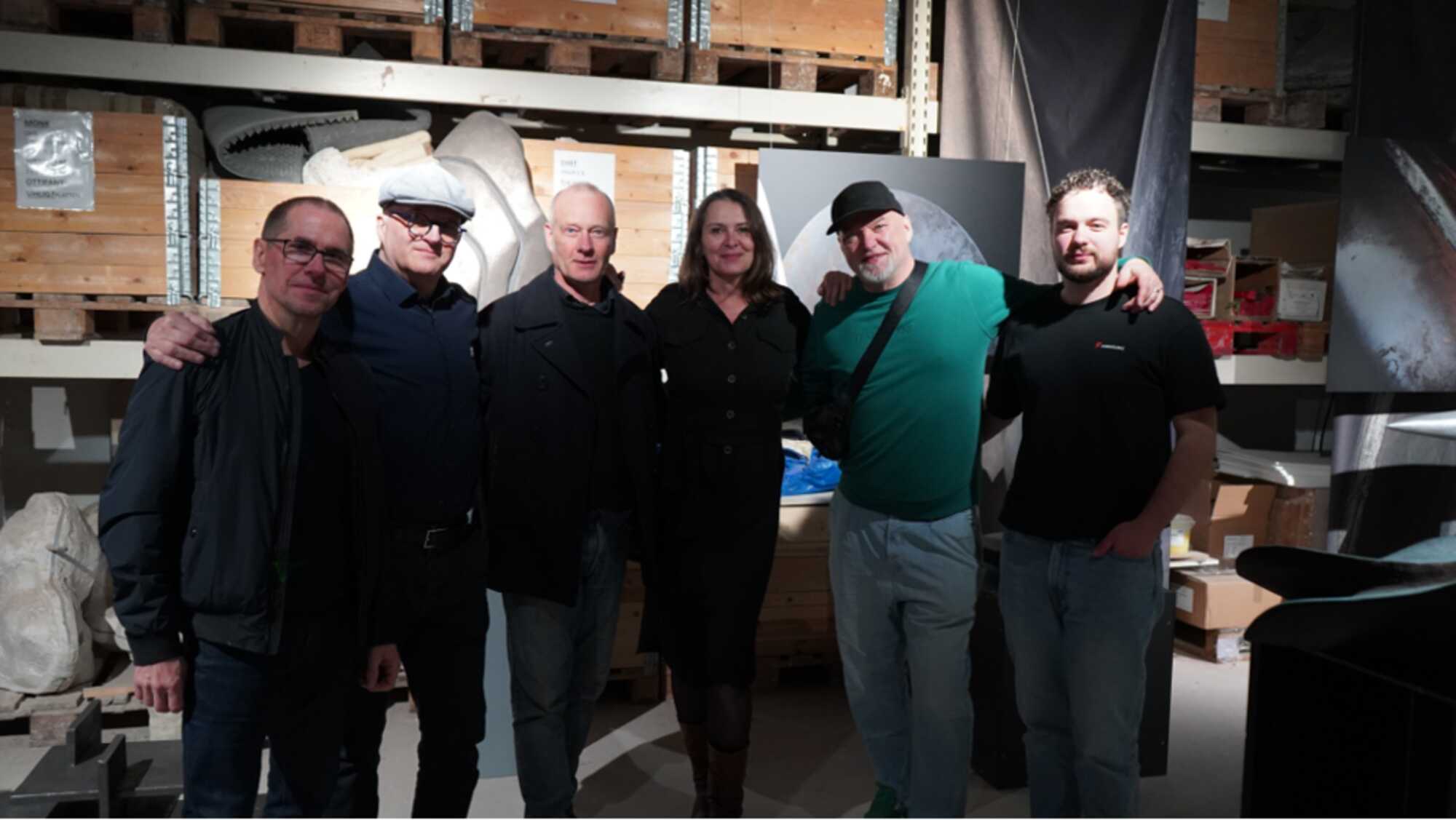
Visions of Art in Architecture was a collaborative project, not a solo endeavour – and therein lies its programmatic message. Hans Heinze accepted Anke Schirlitz’ offer to use the entire foundry as an exhibition space, and he invited his colleagues to join him in creating this gesamtkunstwerk for one evening only. (Incidentally, both Heinze and Schirlitz are members of the Sculpture Network.) This vision is so powerful that it enables other artists to find their own voice within it.

Dreipunkt. /Tiemo Weidemann screened award-winning art films that capture the process of creating the sculptures. Torsten Strom collaborated with Heinze to create eight hybrid artworks in the form of large-format photographs, some of which up to four metres in height, that serve as reflections of the sculptures. Meanwhile, Marco Wallberg presented six digitally created compositions that explore the interplay between identity, culture and fashion, while remaining rooted in the tradition of the classical still lifes. What distinguishes these works from mere projections is their physical realisation. The AI image is not being transmitted, but rather cast. Not projected but preserved. Wallberg lends the most ephemeral of visual media what Heinze lends to clay: form, weight and existence. This is not a contradiction to the bronze; rather it is its digital echo and counterpart. Formscale / Emilio Erbe created large-scale sculptures using 3D-printed models and MIDAS liquid metal, thereby raising the question that preoccupies 21st-century sculpture: What constitutes a design, an original or a work of art?
Nils R. Schultze brought up the element light: “Light is the carrier. It creates spaces and atmospheres.” This evening, his light art was displayed on the second screen, the installations transforming the industrial spaces into “tuned” spaces, as Böhme would have described them. Light emanated from the objects, bathing the room in colour and rendering the atmosphere visible.
The exhibition at the foundry gallery
Until 9 May 2026, the Altglienicke Art Foundry Gallery will be showcasing Hans Heinze’s sixteen most significant bronze works. These are accompanied by ten panoramic visualisations and the art films Minutiae, Sculptura and Bronze. While the evening event offered an intense experience, the gallery gives visitors the chance to pause and contemplate the intricate details of a single bronze surface. A catalogue providing full documentation of the exhibition will also be published.
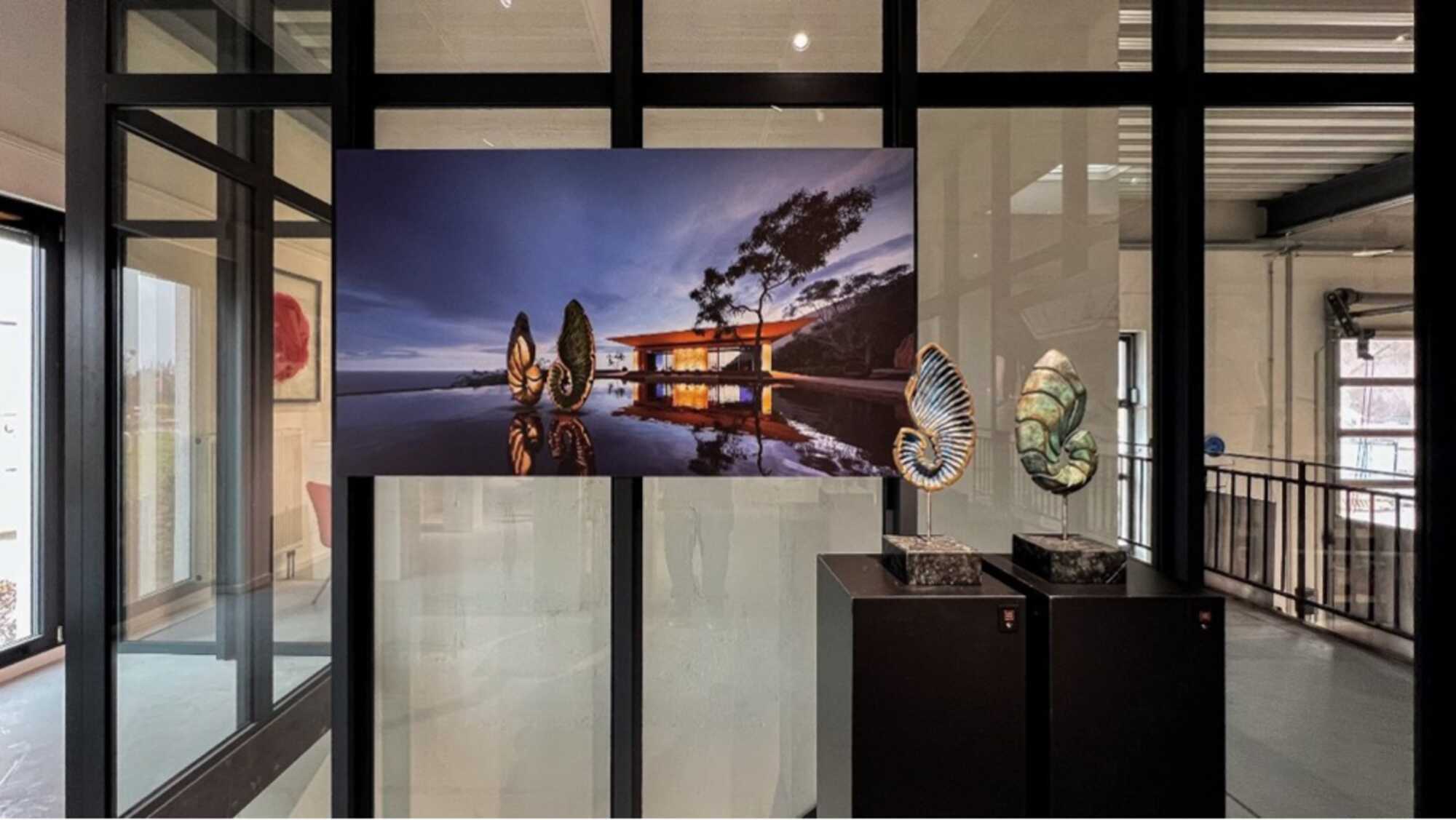
Galerie der Kunstgießerei Altglienicke
Wegedornstraße 46, 12524 Berlin
Monday – Friday, 9:00 – 16:00h | until 9 May 2026
https://kunstgiesserei-altglienicke.de/aktuelle-ausstellungen-und-archiv/
About the author

Anemone Vostell
Anemone Vostell is a Berlin-based cultural manager and founder of BAM! Berlin Art Management – art projects and consulting with a special interest in sculpture, installation art and land art.
Translation
Elka Parveva-Kern
Elka Parveva-Kern supports Sculpture Network since 2024 as a translator - a wonderful opportunity to combine her long-standing interest in languages and art.