n.b.k. and Schinkel Pavilion
Berlin
Germany
Projections Onto the East
10 September 2026 – 20 December 2026 (Schinkel Pavillon)
10 September 2026 – 8 November 2026 (n.b.k.)
Opening: 9 September 2026, 6pm, in the context of Berlin Art Week
Anca Benera & Arnold Estefán, Pavel Brăila, Ana Hoffner ex-Prvulovic*, Maksym Khodak, KwieKulik, Helmar Lerski, Maria (Masha) Lisogorskaya, Shlomo Pozner, Xavier Robles de Medina, Maya Schweizer, Andrzej Steinbach, Gabriele Stötzer, Hito Steyerl, Mikhail Tolmachev, Jasmin Werner, Anastasiya Yarovenko
Starting from the observation that the “East” increasingly serves as a cultural, aesthetic, and political projection surface, the multipart exhibition, discourse, and publication project Projections Onto the East addresses the ideological attributions associated with the terms “East” and “West.”
International artists, scholars, and writers examine historical and contemporary lines of conflict – from GDR memory politics and antisemitism to postsocialist transformations and current geopolitical tensions. Central to the project is the question of how the dichotomy of “East” and “West” structures our present.
“The East” is not merely a geographic designation. It also functions as a cipher: a surface for cultural and political projection, one that draws starkly divergent imaginaries – it is cast as the counter-image to “the West,” or as a place of supposedly more original and unmediated identity. At the same time, it is the site of real historical and contemporary conflicts. The multipart exhibition, discourse, and publication project Projections Onto the East takes this relationship between attribution and reality as its starting point, examining an idealized “East” as a cultural Other to a hegemonic “West.”
“Projections onto the East” mean cultural identifications with whatever appears as the antithesis of “the West”: identifications directed against a present perceived as complex, plural, and modern, and bound up with notions of origin, community,
spirituality, or moral superiority. Culturally and historically, the ambivalent relationship between “East” and “West” has repeatedly triggered major identity crises within the German context. But globally, too, “the East” increasingly serves as a countercultural projection surface: traditional conceptions of culture, national sovereignty, and authoritarian forms of governance are held up against liberal democracies as supposedly stronger, more authentic alternatives.
“The East,” in this sense, becomes a cultural construct, shaped by ideologies, longings, and utopias that often reveal more about those who produce them than about “the East” itself. Such projections frequently obscure the very conflicts they might otherwise make visible. Invoking authoritarian social orders in which contradictions are not publicly negotiated can easily mean mistaking the absence of debate for the absence of conflict. This becomes especially clear in competing visions of freedom: while some seek in “the East” an alternative to a “Western” order they perceive as excessively tolerant and open, others regard “the West” itself as the true seat of unfreedom. In both cases, an idealized image emerges that invents “the East” more than it describes it.
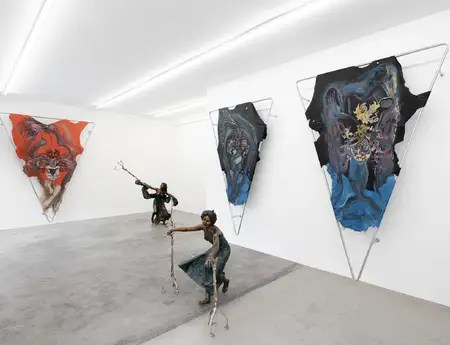
The exhibitions at Neuer Berliner Kunstverein (n.b.k.) and the Schinkel Pavillon examine how these projections inscribe themselves into images, language, and aesthetic forms, and what political consequences they can produce. In the realm of realpolitik, they materialize as relations of power, territorial claims, and violent conflict. Wars and geopolitical crises in particular reveal how rigid ideas shape perception while also generating and legitimizing political reality.
n.b.k. and the Schinkel Pavillon present historical and contemporary artworks alongside new productions developed specifically for the project. International artists, scholars, and writers engage with historical and present-day lines of conflict – from the memory politics of the GDR, to antisemitism and postsocialist transformation, to current geopolitical tensions. The participating artists interrogate “the East” as a projection surface where identity, history, and political order converge. Their works explore, in different ways, how images, language, and aesthetics participate in the construction of “East” and “West.” At the center stands the question of how this dichotomy continues to structure our present.
Not least, the exhibition turns its own gaze back on art: art, too, is not free of projection and idealization. Where does the line run between critique and longing, between resistance and romanticization? And what becomes visible once we take not only “the East” but the projections themselves as our object?
Accompanying two exhibitions at n.b.k. and the Schinkel Pavillon, a publication and a project website bring together artistic positions, research perspectives, and contributions to the discourse. An extensive discourse program delves deeper into these thematic questions.