Companions of “Moments with No Solid Form”: Artworks in the stairwells of public buildings

Stairwells are generally considered mere passageways. Yet it is precisely within these spaces that works of art – especially three-dimensional ones – take on special significance: they accompany us as we pass by, move up, travel through, and transform the way we perceive the space.
Works of art in stairwell halls? At first glance, this seems to be a rather marginal issue: Are the works even perceived as such? In buildings, stairwells fulfil a special role as spatial junctions between the different levels. Christian Schittich describes the function of a staircase as a “built movement in space”, whose purpose it is to connect different floors, but which may also, “on a metaphorical level, become an ascent, even a passage into another world” (Die Erschließung als Konzept, 2013, imDETAIL, p. 9). I cannot help but think of Marcel Duchamp’s Nude Descending a Staircase No. 2 (1912). Stairs are the only place in a building where bodies move vertically, horizontally, and through time all simultaneously.
A stairwell is a space where perception, movement, and social interaction intertwine. When we pass diagonally through a building, we are fully aware of what lies within that passageway. From a prospective point of view, however, this poses a challenging situation for both the artwork and the viewer: The stairwell is essentially not a destination (unless it is made into one; please see below), but rather a space of transit. We do not actually spend time there but rather move between below/above, arrival/departure.
When climbing stairs, the body does not remain in a stable position. The gaze is in motion, the rhythm of breathing shifts, and the horizon tilts slightly. Art is not viewed here from the front and centre with a sense of confidence, but rather in a transitional mode. Our perception is neither fully focused on the artwork nor fully on our destination. Precisely in this situation of divided attention lies a liminal condition: perception without definite fixation. This is probably what makes artworks so particularly present in stairwells: works of art not as something to be confronted but as an accompaniment to a fleeting moment that itself has no definite form.

We encounter such works in universities, schools, administrative buildings, hotels, and museums. The basic distinction here is between the works that were created specifically for a particular building and those that are installed at a later stage. Art in construction is an integral part of architecture and is usually created specifically for a given location tailored to its space and its intended use. One example is the Aubette in Strasbourg, where Theo van Doesburg, together with Sophie Taeuber-Arp and Hans Arp, designed a stairwell in 1928 in which the decor and the stained-glass windows are conceived as part of the spatial movement composition. Ursula Sax’s Seating Staircase and Corresponding Ceiling Sculpture (1971) at the German School in Brussels displays this strong link between architecture and art. Here, the sculpture enters into a dialogue with a staircase that serves both as an area of recreation and a zone of accessibility.
Otherwise, however, stairwells are often narrow and purely functional – and art is only added as an afterthought. Placed art introduces an already existing piece of art into an architectural context. Public institutions in particular are key places for this practice, with opportunities often awarded through competitions or calls for proposals (including the BBK Federal Association (Bundesverband), Competitionline, Wettbewerbe-aktuell.de, the Kunstbüro (Art Office) Baden-Württemberg, the IGBK – International Society of Fine Arts, and the Hannover Art Association’s (Kunstverein Hannover) annual call for proposals: www.stufenzurkunst.de).
An example of this is Frank Riepe’s text-based work Das Erhabene in mir grüßt das Erhabene in Dir (The Sublime in Me Greets the Sublime in You) (1999), installed on glass doors in the stairwell hall of the Bremen Police Headquarters. The intervention, and its intrusion into the existing structure, become apparent on ascending or descending the stairs – and it immediately provoked considerable resistance from the civil servants. This, too, demonstrates the power of art. Even in staircase halls! (Thanks for pointing this out to Matthias Moseke, who oversaw the programme for the City Gallery at the time.)
Universities are also important venues for such work. At the Bauhaus University in Weimar, for example, Oskar Schlemmer’s figurative reliefs and the floating figures of the mural on the spiral staircase have been linking the movement patterns of the human body with the architecture of the space since 1923.
Stairwells in museums, meanwhile, are often deliberately designed as distinct spaces for experiencing art. One example is the exhibition Art in the Stairwell at the Stedelijk Museum Schiedam. Here, the stairwell serves as an exhibition space where artistic interventions invite visitors to pause and reflect. Following the renovation in 2022, the exhibition Art in the Stairwell opened with five works by Femmy Otten, Iriee Zamble, Joana Schneider, Jennifer Tee, and Timo Demollin. Since then, additional works have been acquired to expand the exhibition displayed in the stairwell. From the current arrangement, three sculptural works by Tomáš Libertíny, Zoro Feigl, and Timo Demollin shall be presented as examples:
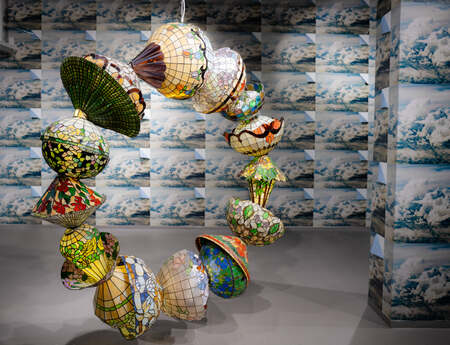
Tomáš Libertíny’s work Memento Vivere / Here You Are (2023) views sculpture as a collaboration between artists and natural processes: bees shape the wax and create a fragile structure that evokes the cycle of becoming and passing away. Within the context of the movement of the stairs, the work appears as a condensed moment within a larger continuum of time. Further details on the sculptures created with bees may be found in Etienne Boileau’s interview with the Slovak artist.
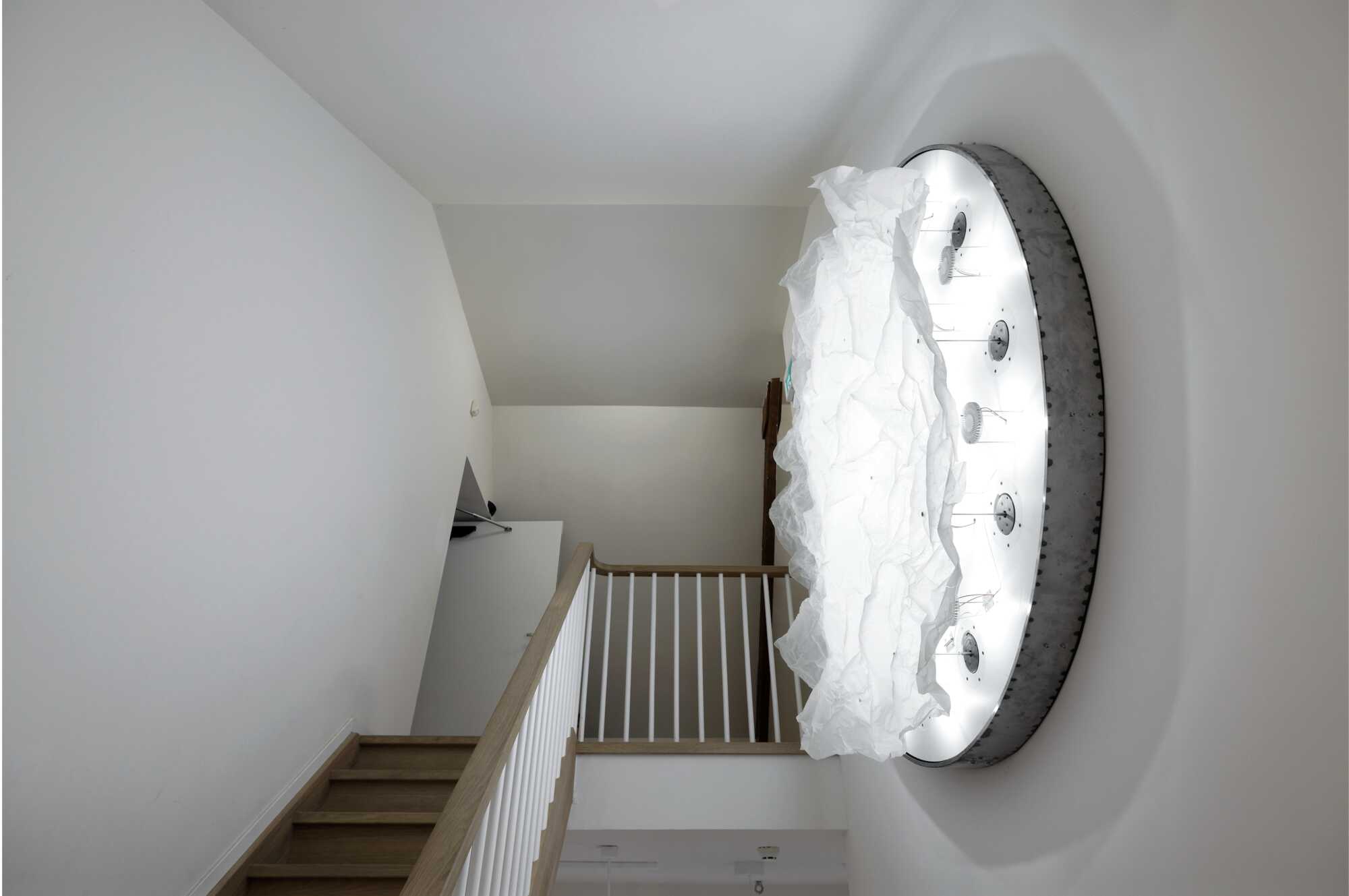
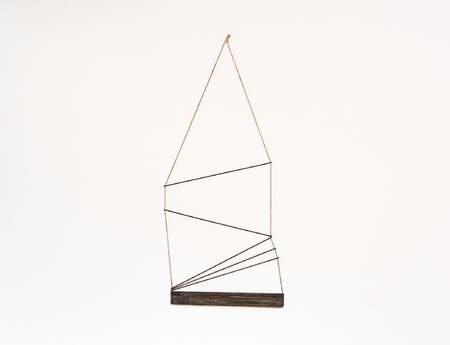
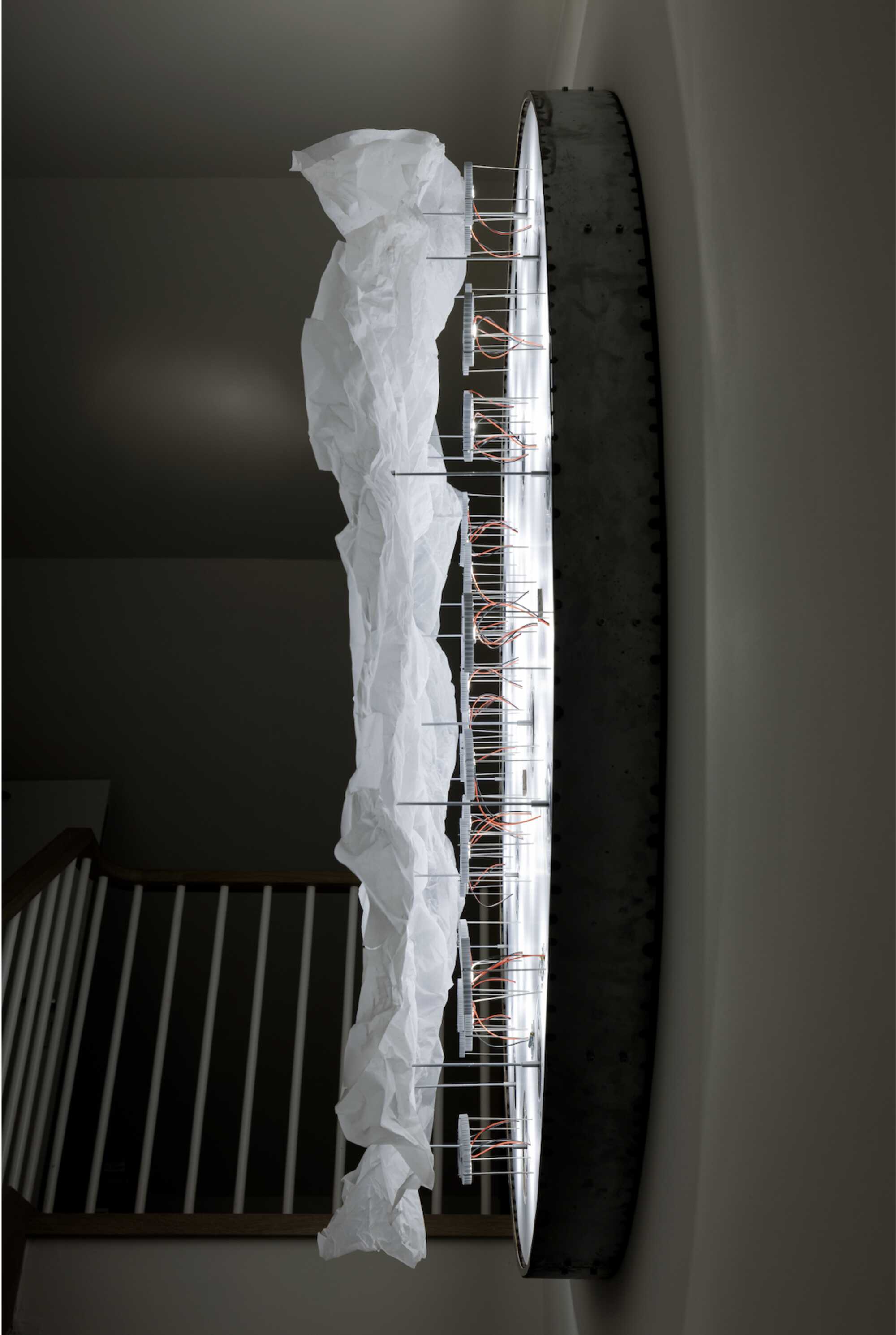
Zoro Feigl’s kinetic sculpture Phaethon (2024) explores movement both physically and metaphorically. An electromagnet causes a paper circle to vibrate, while high-frequency light flickers across its surface. As both rhythms are asynchronous, a visual state of levitation is created: Feigl’s work thus shifts the sculptural object from a fixed concept of work to an unstable counterpart in space, whose seemingly independent movement subtly disrupts the continuity and self-evidence of one’s own movement and, moreover, creates a dynamic within the space.
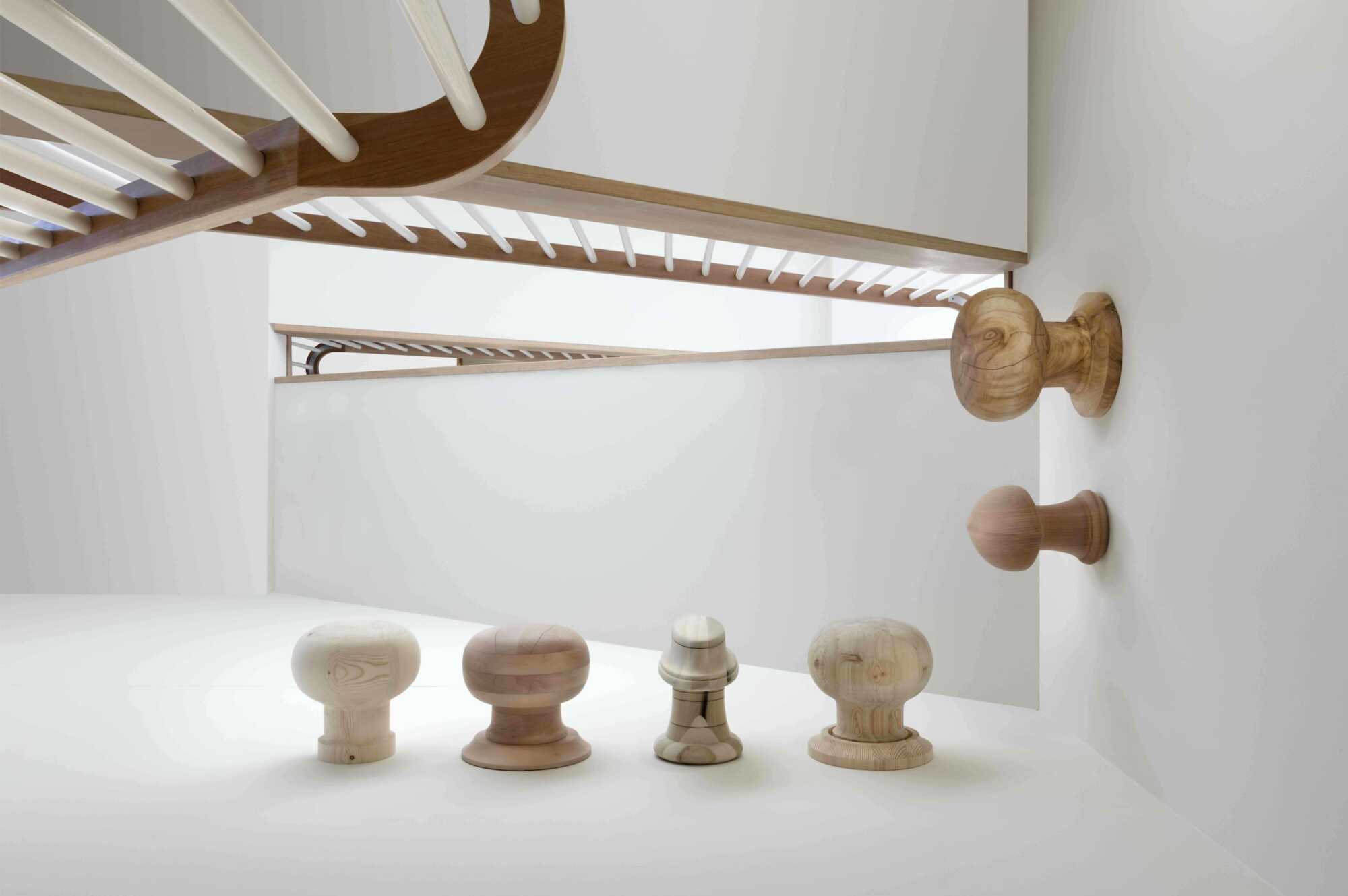
Timo Demollin’s Turns (2022) alters the perception of space through minimal interventions. This work is based on historical door knobs from the building dating from around 1880 to 1919, which have been transformed into abstract wall sculptures. The work evokes turning and changing direction – central aspects of movement in a stairwell. The sculpture has the effect of a spatial marker that makes visitors consciously aware of their own movement.
It turns out that works of art in stairwells engage with our experiences in a different way than when we view art in the usual setting. This presents a challenge for both artists and curators.
Especially three-dimensional works in the stairwell hall are more than just objects in a given space when they cross our path during this strangely diagonal transition. And invite us to pause – not just to traverse this place, mostly used collectively, but to perceive it as a space of conscious encounter. More of this, please!
This article was originally written in German by Jana Noritsch.
About the author

Jana Noritsch
Jana Noritsch is a freelance author who has been working at the intersection of artwork, archives, and collections for nearly 20 years.
Translation

Sybille Hayek
Sybille Hayek is an editor and translator. Since 2022 she has been supporting our team on a voluntary basis with her trained eye for detail and a great love of language.