Dutch artist Maria Roosen says: “Scrub, Rake, Pour, and Sweep”

What would the Dutch art world be without Maria Roosen (1957, Oisterwijk, NL)? Her influence on contemporary art is enormous. Her work explores themes of growth, blossoming, fertility, love, and transience and is frequently shown during group exhibitions focusing on the female perspective, at unusual cultural heritage sites, and outdoors in the public space (Sprengenpark Arnhem). Stedelijk Museum Schiedam pays homage to Maria Roosen with an exhibition of more than 80 well-known works, carefully laid out in four museum rooms.

The exhibition includes an enormous variety of glass objects, installations, and drawings. Many of these artworks convey a kind of subtle humour and laughter. Visitors are not only offered a retrospective of the artist’s versatile work but are also allowed an insight into her working process. Roosen’s artworks often evolve from personal emotions, made tangible in soft and hard materials like glass, paper, and textiles. Most of these works derive from a series of ‘Dagboektekeningen’ (diary drawings). As for her glassworks, she makes use of professional glassblowers.
The Jug as a Symbol
Although Roosen is best known for her breast- and penis-shaped sculptures – varying from one or two hanging breasts or penises to entire bunches of them – she considers the jug truly symbolic for her work. The jug represents pouring and receiving. It is a vessel for fluids, but it has also evolved from fluid matter itself; in the first place from watercolour paint – drawings are the basis of her work – and subsequently from glass. Therefore, the jug, as a pre-eminent poetic symbol in her work, makes frequent appearances in this exhibition: Jugs are attached to the walls of the museum, dropped on a couch, or placed one after another on the ground as a series.

“My working method is inextricably linked to growth, and this applies to making glass as well as to knitting. Growth is the strongest force there is; just look at nature.”
Working method
The exhibition’s title, Scrub, Rake, Pour, and Sweep, refers to Roosen’s intensive working method during which everything evolves from her perception and intuition. The practical, repetitive actions involved in her working process allow her to arrive at the essence of what she wants to tell in her work. Glassblowing, for instance, is a process of growth and collaboration, with the blown bubble slowly transforming into a shape. It involves chance, as she collaborates intensively with glassblowers who do the heavy blowing work, while she gives them instructions.
Contradiction between hard and soft
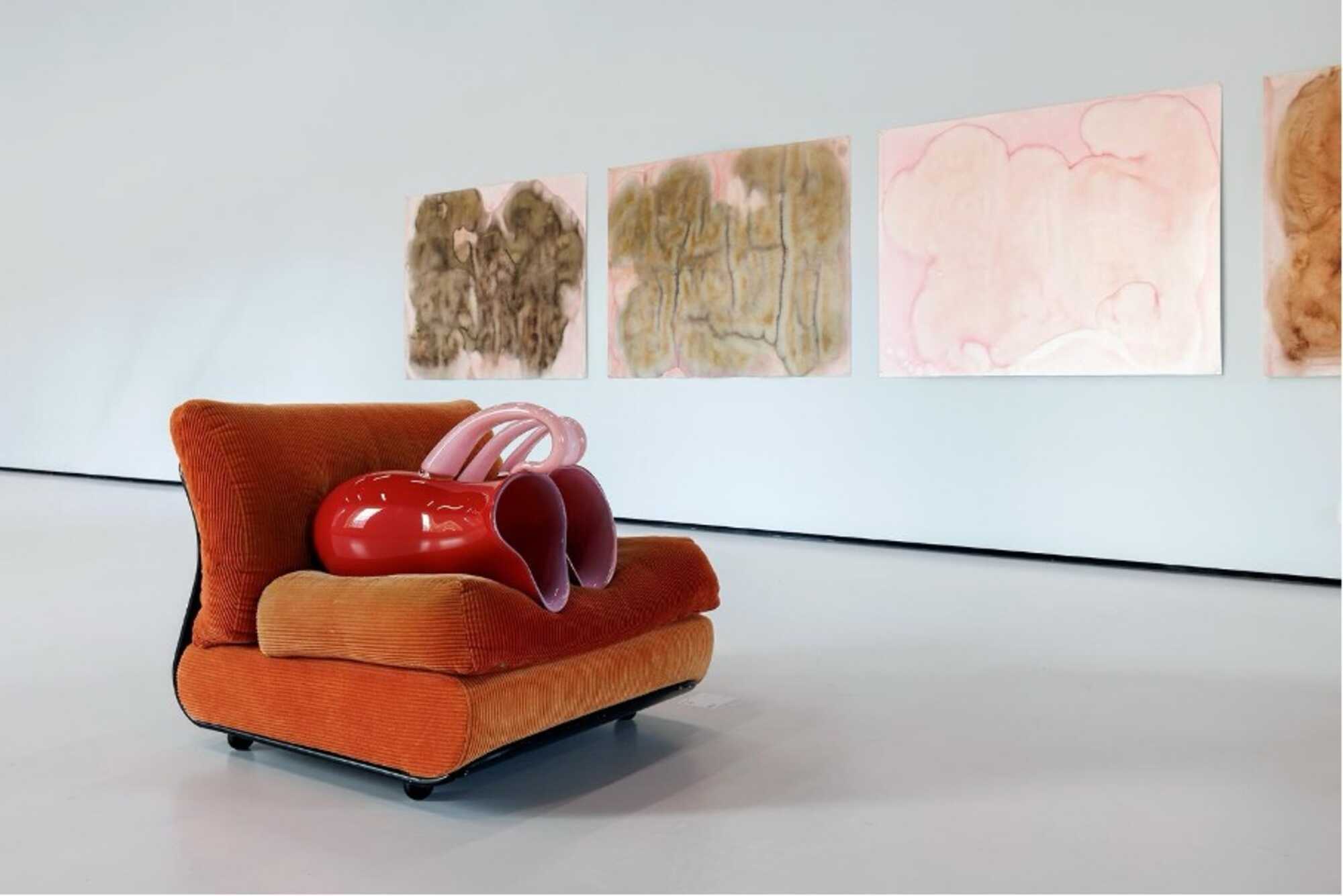
Featuring a total of eighty artworks, the exhibition immerses visitors in the world of Maria Roosen, allowing them to find out which common threads run through her work. Over fifty of these pieces are taken from Maria’s own collection and have rarely, if ever, been exhibited before. I felt strongly attracted by the installation called Nest: three jugs made from glass, placed on orange sofa cushions, which makes their position delicate and at the same time vulnerable. Another important piece shown at the start of the exhibition is a drawing that has never been shown before. It depicts a gun enveloped in a soft, deep pink, fluid watercolour paint film. The artwork questions the contradictions between hard and soft, male and female.
“In the beginning of my art practice, it was absolutely not done for artists to say that their work had evolved from their intuition. It was dismissed as art for women. The fact that today there is more space and acceptance for this is wonderful, but at the same time also a dire necessity.”
Fluidity as an attitude to life
In Maria Roosen’s way of working, ‘fluidly moving along with the stream’ is an important connecting thread; this statement can be taken literally regarding her use of watercolour paints and molten glass but also figuratively, referring to her mentality. The intensive collaboration in the creation of this exhibition with curator Inez Piso-Tuncay has resulted in a call for tenderness, openness, and intuition in a world filled with judgements and harshness. And there is humour and laughter in her work: for example, the funny jug that has been fully dressed by her mother with a woollen cable-knit jumper to go over the cold glass of a big jug that she just had created. To her, ‘it almost creates a living being.’ Roosen proves with this artwork and with other exhibits that all her works are, in fact, self-portraits.

Gesturing bodies
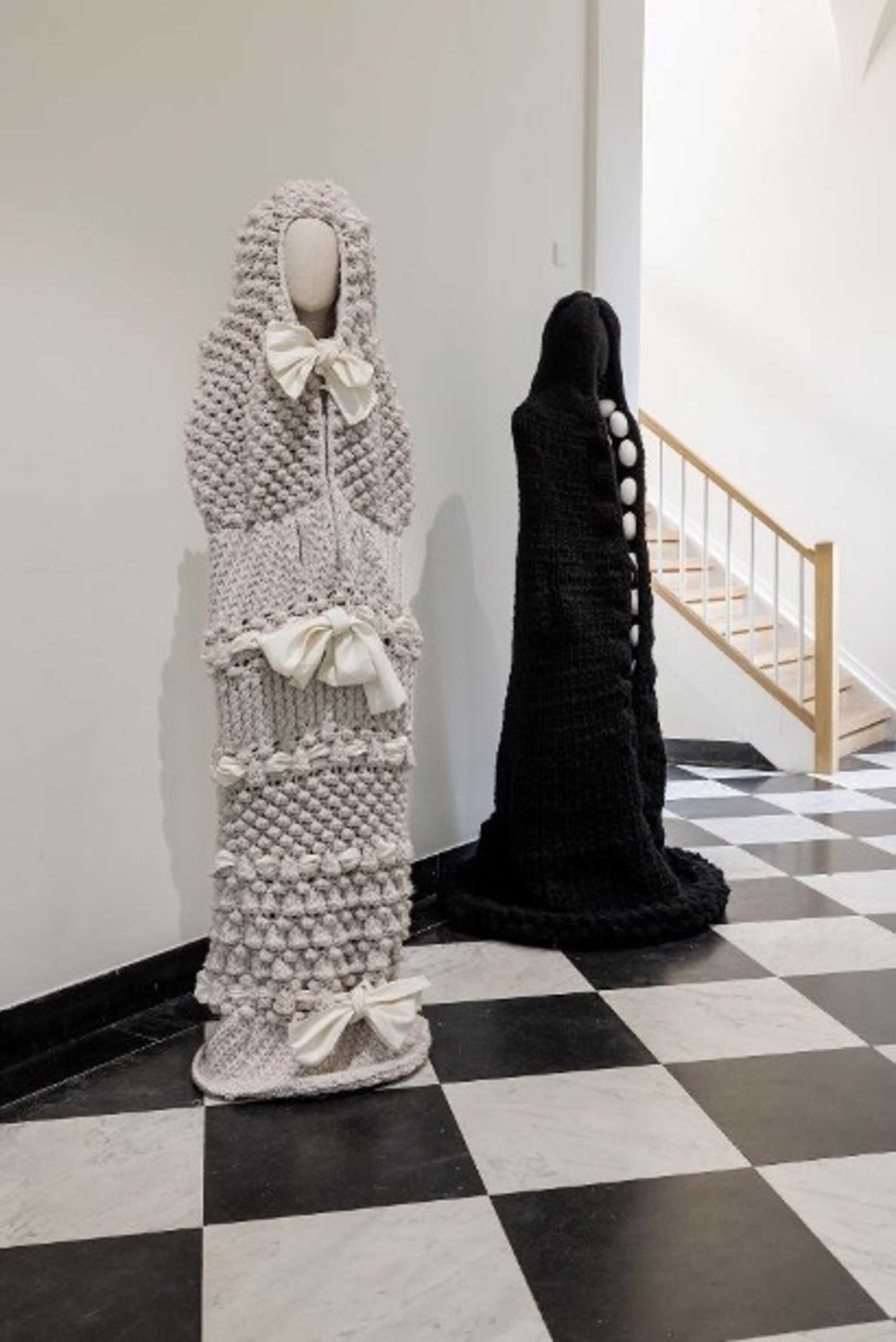
As for the work Self-portrait waiting and some other drawings and objects, you could say that Roosen focuses on gesturing bodies, not in a traditional way but in a delicate conceptual way. For example, look at the two figures dressed up in long woollen, black and white dresses, standing in a corridor of the museum. They are something in between guards and fashion dolls. The white one carries three big bows on her dress, and the other one has some decorative jewellery around the neck. Haute Couture 2025 is the title of the white dress, and the black dress is titled Soft Shelter (Artemis). Hard to say if the bodies are male or female. Roosen about the phenomenon of bodies:
“I am extremely focused on the body in my work. I can feel exactly where everything is in my back: where certain feelings and people literally have a place in my body.”
Coincidentally this year’s Sculpture Network Forum, which takes place this autumn in Berlin, has the title Bodytalk – The Return of the Human Figure in Contemporary Sculpture. Curator and art critic Anne Berk wrote: “It’s all about gesture in conceptual figuration: how these silent figures speak to our bodies in a language we all know. In rapidly changing times, artists use the gesturing body to communicate their questions about life, addressing themes such as the body, sexuality, mortality, identity, love, power, technology, and our relation to nature. Unlike the monumental sculptures of the past, which stood above us and dictated meaning from their pedestals, today's figures stand on the same level as the viewer. They meet us eye to eye. This ‘conceptual figuration’ is not about delivering answers. In a fragmented world, these gesturing figures invite us to reflect.”
Stedelijk Museum Schiedam
Maria Roosen / Scrub, Rake, Pour, and Sweep
22 November 2025 – 3 May 2026
https://stedelijkmuseumschiedam.nl/tentoonstelling/maria-roosen
www.sculpture-network.org/en/event/86894/xvi.-international-forum
Etienne Boileau wrote this article in English.
About the author
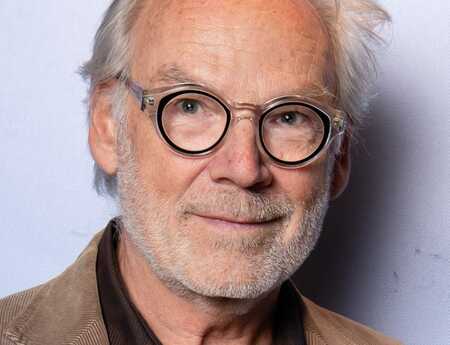
Etienne Boileau
Etienne Boileau is a Rotterdam based journalist and writer.
Translation

Sybille Hayek
Sybille Hayek is an editor and translator. Since 2022 she has been supporting our team on a voluntary basis with her trained eye for detail and a great love of language.