Kunsthalle Wien
Museumsquartier, Museumsplatz 1
1070 Vienna
Austria
Chalisée Naamani: Octogone
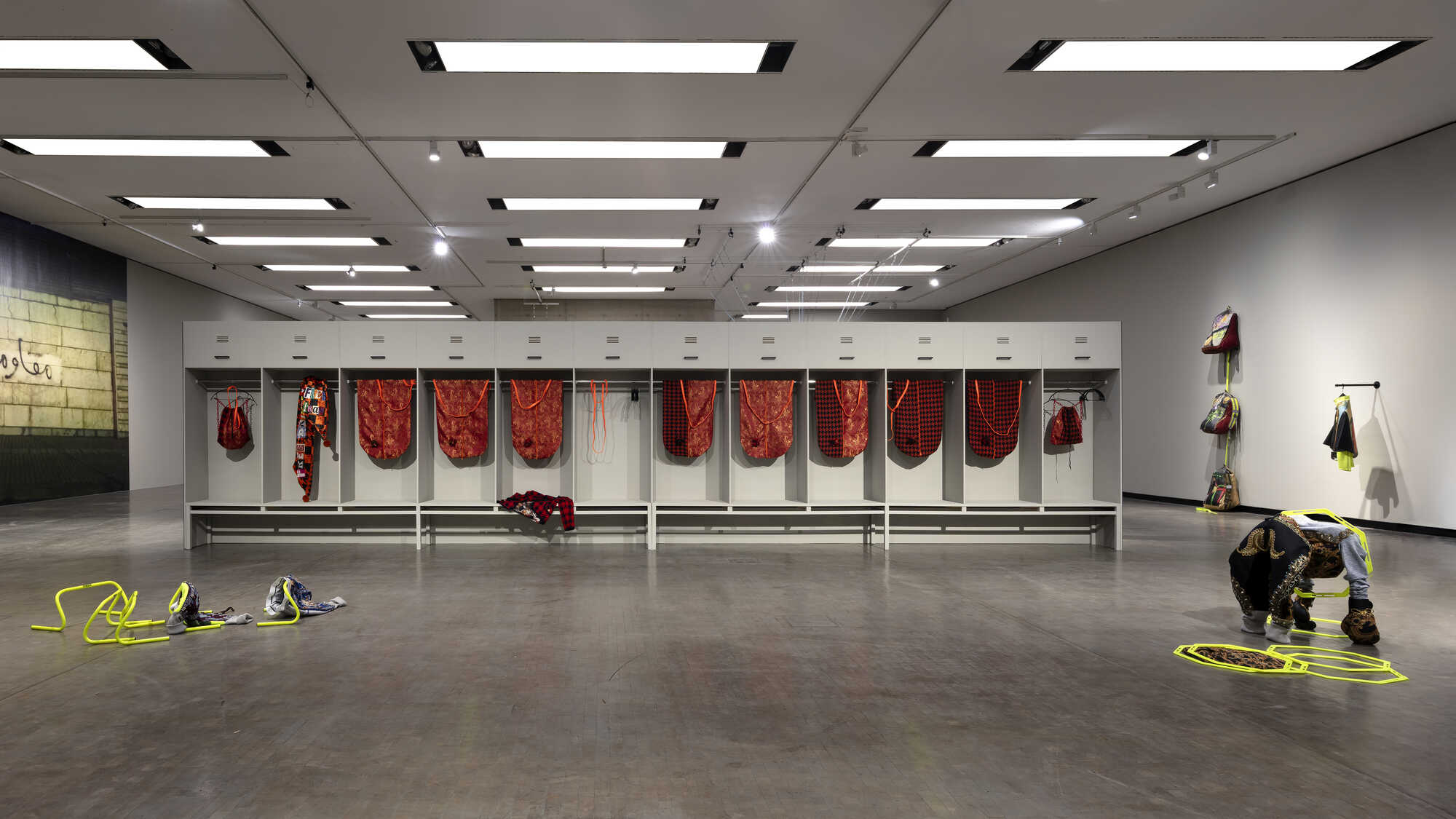
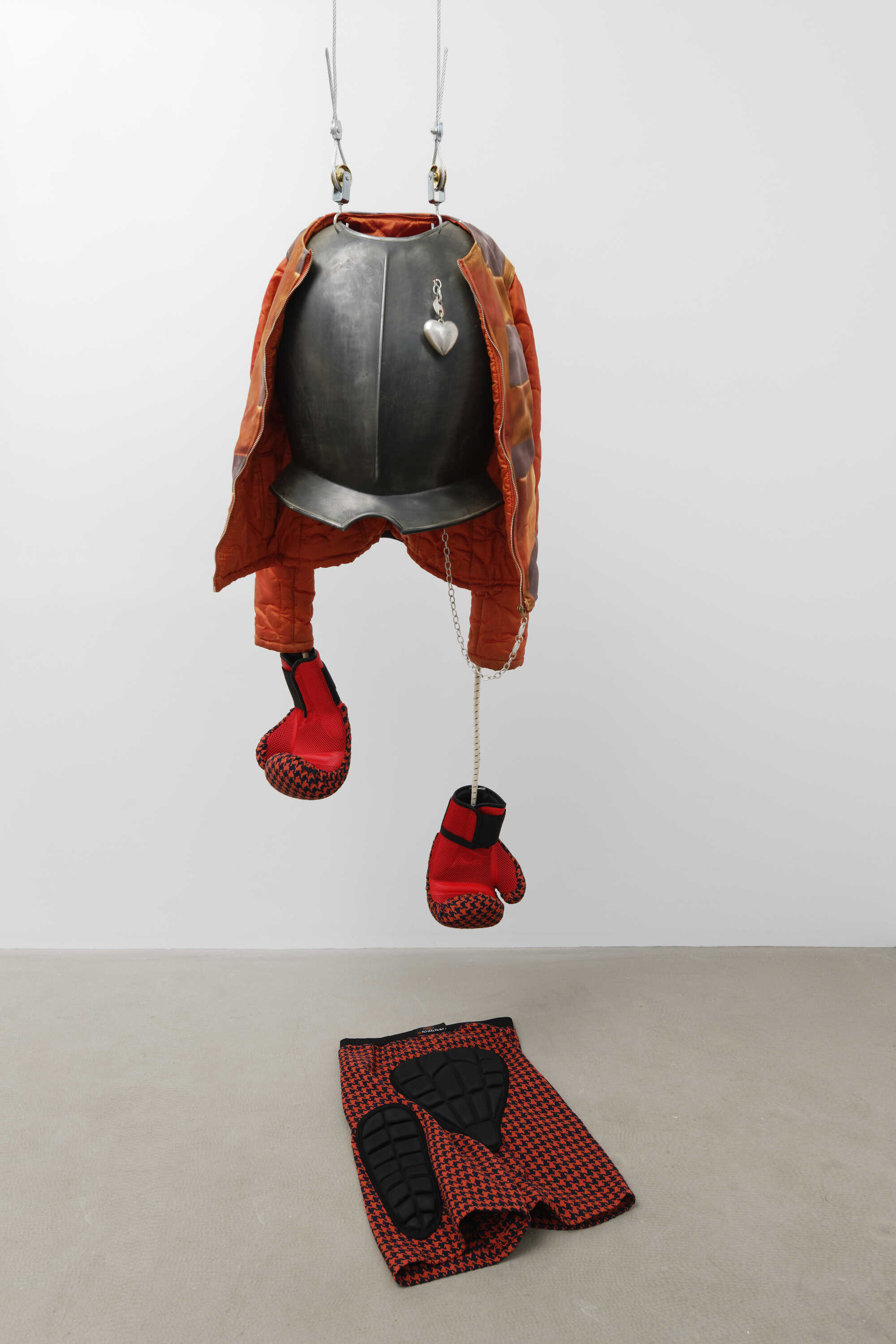
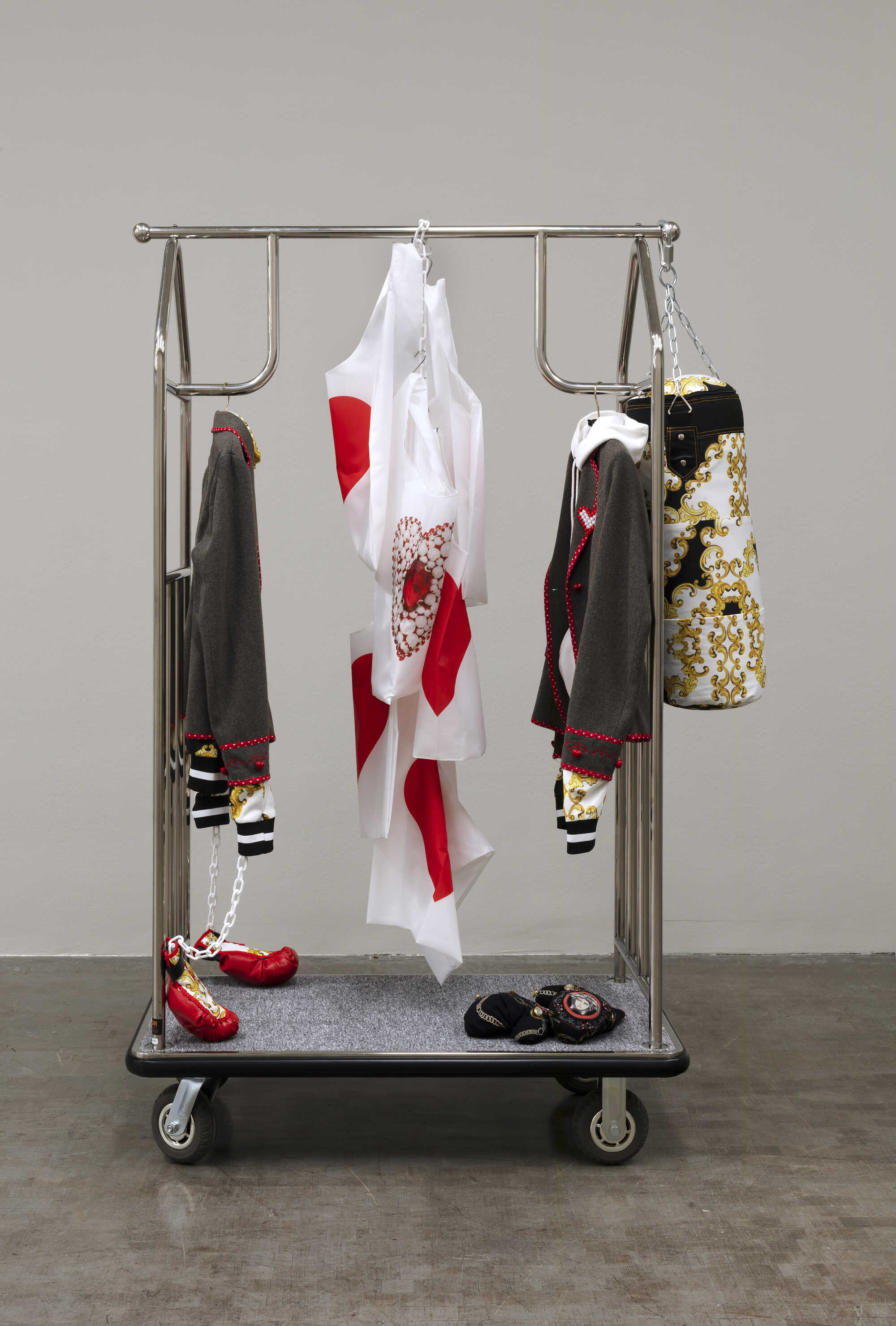
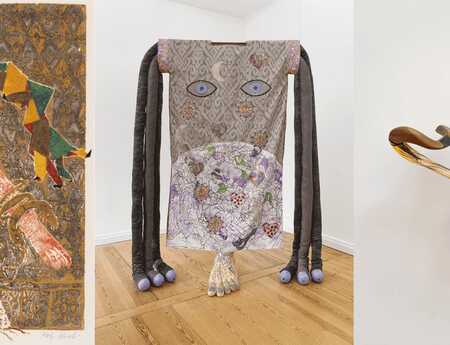
Kunsthalle Wien presents the first solo exhibition outside France by the French-Iranian artist Chalisée Naamani (b. 1995, Paris). Entitled Octogone, the exhibition at the Museumsquartier includes a series of new commissions alongside recent sculpture, print and textile works. Naamani describes her sculpture as ‘image-garments’, produced via a process of layering and collaging images, fabrics and text from diverse sources. While her objects often resemble items of clothing or refer to the history of fashion, they are never intended to be worn. Instead, her sculpture positions fashion as inherently political, drawing upon the applied arts to reveal how questions of form, function and aesthetics are bound to power and cultural meaning. Informed by a wide range of sources, Naamani’s works bring together ornamental traditions from the decorative and fine arts, Persian and Christian iconographies, quotations from popular culture and the internet as well as personal photographs and archival material.
Several sculptures engage – both formally and symbolically – with the visual language of international protest movements and political resistance, envisioning garments as potential carriers of emancipation. From Iran (2025), for instance, refers to the protests against the government of the Islamic Republic of Iran, which are in turn associated with the initiative ‘Woman, Life, Freedom’, formed in response to the death of Mahsa Amini while in police custody in 2022. Elsewhere, Cape et gilet jaune (2020) cites the clothing of the French protest group ‘Gilets Jaunes’ [Yellow Vests], whose name originates from a high-visibility garment, combing functional with political needs. This engagement continues with the newly commissioned sculpture No Kings, Only Queens (2026), which addresses the recent struggles for transgender rights in the United States of America. Another example is Liberty Leading the People (2026), titled after Eugène Delacroix’s painting La Liberté guidant le people (1830), which still serves as an iconic image for revolutionary aspirations long after the French July Revolution. Central to Naamani’s practice is the dissemination of images and symbols that accompany these movements and the processes of translation they undergo – historically and within today’s condition of constant reproduction and appropriation via social media. At the same time, the works trace the cultural circulation of images and garments within a globalized world, shaped by migration, tourism and the networks of production, display and consumption that shape the fashion industry.
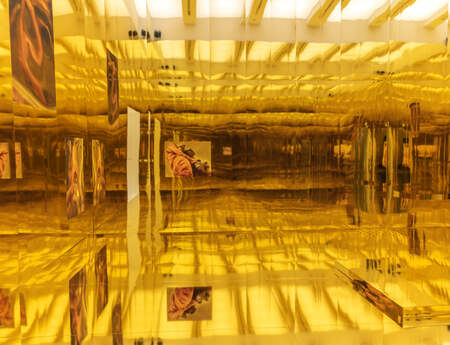
The title and design of the exhibition refer to the Zurkhaneh [House of Strength]: In Iran and neighbouring countries, this training space features an octagonal ring and is dedicated to the practice of Varzesh-e Pahlavani, a martial art rooted in the pre-Islamic period. Following the Arab conquest of Iran in the seventh century, the sport was banned due to its perceived revolutionary potential as a form of cultural and physical resistance. Naamani’s exhibition and its scenography (resembling a changing room with lockers and mirrors) intersects this aspect of Iran’s cultural history with that of the artist’s family. She refers to her grandfather who practised the sport and appears in a black-and-white photograph wearing his medals. These images are embroidered onto capes modelled on traditional training attire within the installation Who claims love (2025). More recently, the practice of Varzesh-e Pahlavani — long dominated exclusively by men — has been claimed by women in the context of emancipatory movements in Iran. The artist cites other sports historically coded as male, such as boxing and football. By combining, for instance, training equipment with objects used for the cognitive development of young children, she draws on her own experience of motherhood while reversing entrenched gender stereotypes and deconstructing societal ideals of growth, optimisation and bodily discipline.
A new series of works extends these reflections to local cultural references. In these sculptures, Naamani examines how traditional garments such as the Dirndl and Lederhosen encode and reaffirm gendered ideals through their design and the ways in which they limit bodily autonomy. Naamani combines these garments with merchandise produced for tourists and T-shirts that feature the word Heimat, raising questions about the meaning of belonging today and the danger of its nostalgic idealisation, particularly in the context of nationalism and the rise of the far right.
The exhibition Chalisée Naamani: Octogone is organised in collaboration with Palais de Tokyo, Paris.
Biography
Chalisée Naamani (b. 1995, Paris) has held solo exhibitions at Palais de Tokyo, Paris (2025) and La Galerie – Centre d’art contemporain de Noisy-le-Sec (2021). Her work has also been exhibited at institutions including Le Delta, Namur (2025); Hangar Y, Meudon; FRAC Champagne-Ardenne, Reims (both 2024); MUDAM Luxembourg; La Friche La Belle de Mai, Marseille (both 2023) and the Biennale de Nice (2022). Naamani received the Pista 500 Prize from the Pinacoteca Agnelli, Turin (2023) and the Benoît Doche de Laquintane Prize (2021). Naamani lives and works in Paris.
Limited Edition
Chalisée Naamani has created a scarf as part of Kunsthalle Wien’s series of artists’ editions. It takes the form of a football scarf with the slogans ‘Free Britney’ and ‘Free Iran’. Its political message refers on one side to the liberation movement in Iran and on the other to the campaign to free pop singer Britney Spears from her father’s guardianship. Both slogans were widely spread via social media and are connected by their shared reference to patriarchal systems and the oppression of women.
Kunsthalle Wien’s editions are available from the shop at Kunsthalle Wien Museumsquartier and Karlsplatz as well as online: https://kunsthallewien.at/en/shop. Sales proceeds support Kunsthalle Wien’s programme.
Notes to Editors
Chalisée Naamani: Octogone
29 January–6 April 2026
Kunsthalle Wien Museumsquartier
Press conference: 28 January 2026, 12 am
Exhibition opening: 28 January 2026, 7:30 pm
Public Programme Wed, 28.1.2026, 6:30 pm Artist talk: Chalisée Naamani in conversation with Noit Banai, Professor for Diaspora Aesthetics, Akademie der bildenden Künste Wien Kunsthalle Wien Museumsquartier, Studio
Thu, 5.2.2026, 6 pm Curator’s tour with Anna Marckwald (DE)
Sun, 22.2.2026, 4 pm Guided tour (DE) – Free Sunday supported by Dorotheum
Sat, 14.3.2026, 2 pm Guided tour in Farsi by Nargol Gharahshir (FA)
Thu, 2.4.2026, 6 pm Guided tour (EN)
Programme for Kids and Families Tue, 24.2.2026, 11 am Baby-Friendly tour (DE)
Sat, 7., 14., 21., 28.3.2026, 11 am–12:30 pm Tue, 31.3.2026,10–11:30 am and 2–3:30 pm
Wed, 1.4.2026, 10–11:30 am and 2–3:30 pm
Thu, 2.4.2026, 10–11:30 am
Small Pendants – Powerful Symbols: Workshop for kids and families (DE/EN)
All dates for guided tours and the programme are available at: https://kunsthallewien.at/en/programme