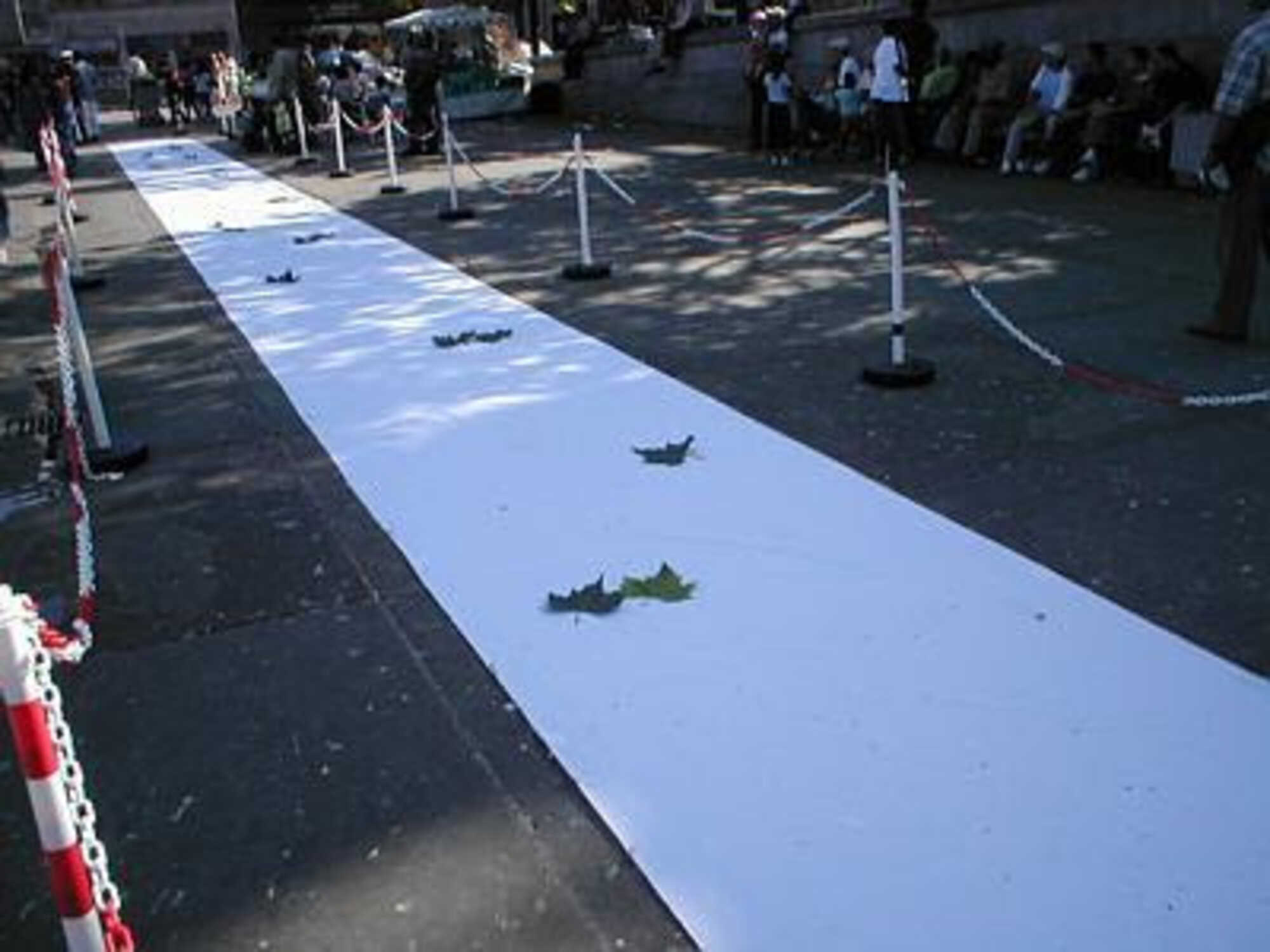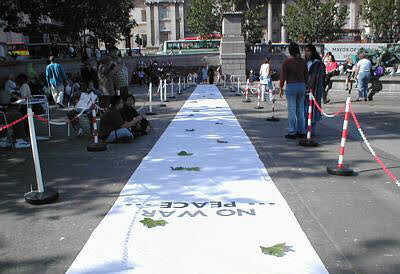
White Letter was a 50-metre-long public installation by Abu Jafar, presented in Trafalgar Square, London, shortly before the Iraq War and preceding the historic anti-war march that drew nearly one million people to the city. Made from white silk and scattered English maple leaves, the work carried the message NO WAR PEACE. Conceived as an open letter to world leaders, the installation transformed a message for peace into a large-scale public artwork, inviting reflection on the human cost of war and the shared responsibility for peace.
White Letter
Trafalgar Square, London, UK
Trafalgar Square, London, UK
White Letter 2002
Abu Jafar
Trafalgar Square, London, United Kingdom
14 August 2002
Installation, approximately 50 metres long and 1.5 metres wide, white fabric, lettering, green leaves, public space intervention.
White Letter 2002 was a large-scale public installation created by Abu Jafar in Trafalgar Square, London, at a moment of growing international tension and conflict. Consisting of a long white pathway punctuated by scattered green leaves and textual elements, the work transformed one of London's most symbolic civic spaces into a site for contemplation, dialogue, and collective reflection.
According to the artist's original statement from 2002:
"It was a statement of the current conflicting world that we live in, where millions of people are killed by the actions of a few and some of them are going to kill more and more. We want peace, not war, and no killing of any human. We do not like to see any inhuman UN embargo on any country. War and embargo both are crimes against humanity."
The installation proposed an alternative language to political rhetoric. Rather than employing confrontation, it used simplicity, scale, silence, and openness. The white ground functioned as both a letter and a space of absence, inviting the public to project their own thoughts, memories, and hopes onto the work. The scattered green leaves introduced a fragile but persistent symbol of life, renewal, and coexistence.
A contemporary description published at the time characterised the project as "a simple conception of art and politics together which is louder than the voice." This observation remains central to understanding the work. The installation did not seek to illustrate conflict directly. Instead, it created a quiet interruption within the urban environment, allowing peace itself to become visible.
Viewed today, White Letter 2002 can be understood as an early example of socially engaged public art that addressed global humanitarian concerns without relying on spectacle. Produced in the period immediately preceding the Iraq War, the work anticipated many of the debates surrounding war, intervention, human rights, and international responsibility that would soon dominate public discourse.
The formal economy of the installation is significant. The extended white surface can be read simultaneously as a pathway, a page, a banner, a letter, or a field of possibility. The absence of extensive text leaves the work open, transforming the "letter" into an unfinished message addressed equally to political leaders, communities, and passers-by. The public walking around the installation became participants in its meaning, completing the work through their presence.
The project also reflects a recurring theme throughout Abu Jafar's practice: the belief that art can act as a connective force between people, cultures, and ideas. Rather than positioning itself within national or ideological divisions, White Letter 2002 affirmed a universal human concern for peace, dignity, and friendship.
As the artist wrote at the time:
"This work is for peace and friendship... to take the message around by the summer breeze to the people who are viewing the work... Peace! Peace!! Peace!!!"
More than two decades later, White Letter 2002 remains a poignant reminder that the quietest gestures can sometimes carry the most enduring messages.