Tell Me Where Home Is
Exhibition Opening on Friday, September 18, at 7 pm, featuring a “State reception” for President Manaf Halbouni and Prime Minister Christian Manss of Mobilistan, the world’s first mobile state in a limousine
What does “home” (German: Heimat, pl.: Heimaten) mean today? Is it even a geographical place, or rather a feeling, a memory, an illusion? How do people in the twenty-first century continually create new homes? In its thematic exhibition Tell Me Where Home Is, the Kunstmuseum Wolfsburg explores the currently intensely debated questions regarding home, migration, and belonging. For even our globalized and digitized societies are imbued with a longing for home—despite, or perhaps precisely because, constant change and migratory movements have become the norm. War, persecution, and the climate crisis are forcing millions of people to leave their homes. Only a small fraction enjoys mobility as a cosmopolitan way of life.
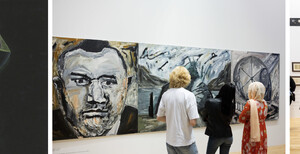
How, then, do people find a sense of home in this turbulent world? Some 160 works by sixty-one contemporary artists on display in the museum’s main exhibition hall illustrate how we lose, gain, and collectively create homes. Houses, cities, and landscapes can evoke feelings of being at home. However, these feelings are often no longer tied to a specific place, but rather to family, friends, religion, music, language, food, or social networks. For many who have migrated—whether voluntarily or involuntarily—the cell phone, as a repository of social relationships, serves as their home port. And often, homes seem to be, above all, romanticized (childhood) memories of a place that may never have actually existed in this form.
The exhibition finds powerful images to address complex questions: Alfredo Jaar, for example, stacks One Million German Passports into a massive block to commemorate the refugees who were taken in by Germany in the wake of the Syrian civil war. After all, the possibilities for finding a sense of home depend largely on the right paperwork.
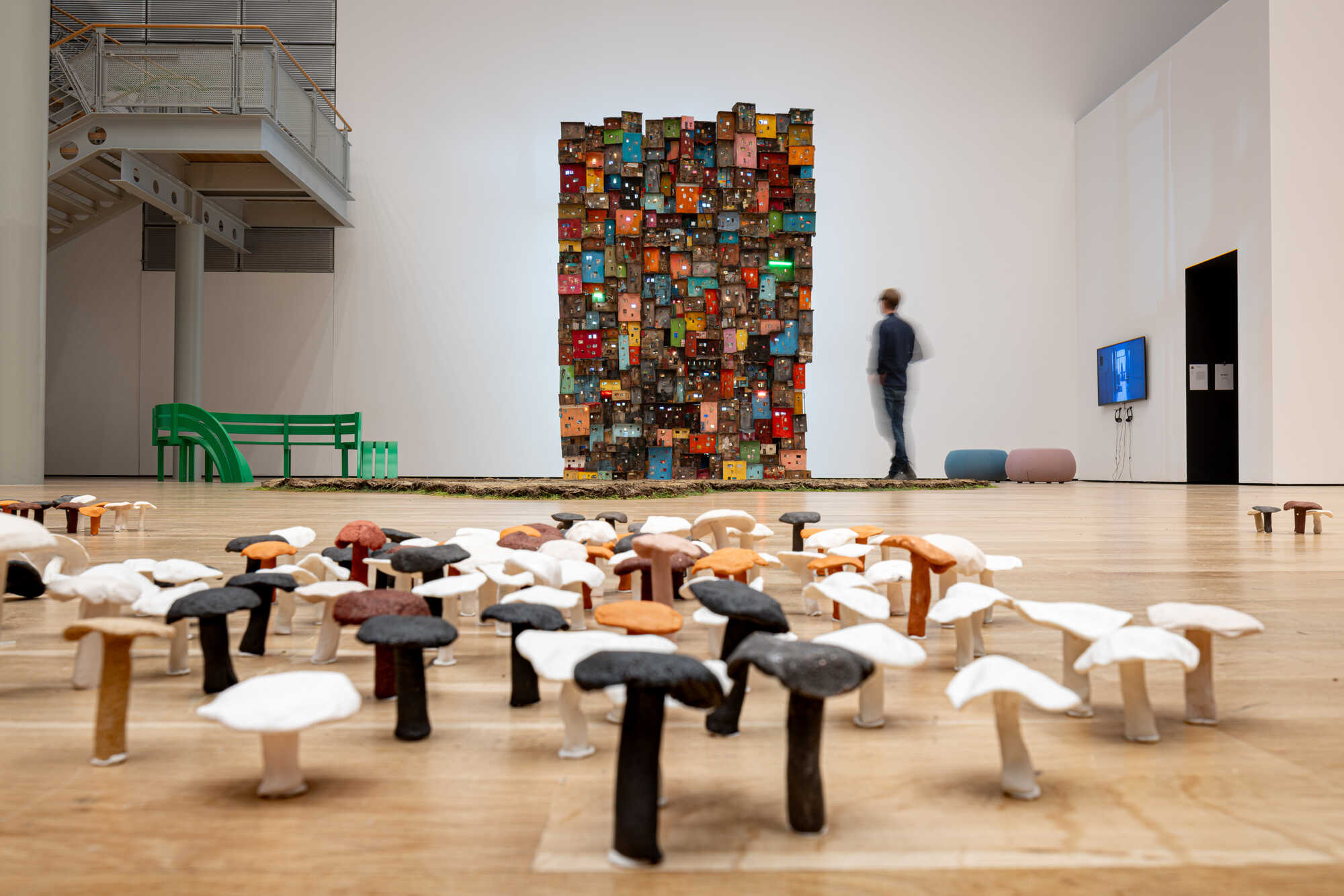
Coco Olakunle’s photographic portraits subvert common clichés by showing how people shape their lives even under adverse conditions in refugee camps. Ishita Chakraborty forms an inclusive Europe out of clay mushrooms of every skin color, while Diana Scherer follows nature’s example, translating contemporary, “networked” society into a pattern of roots—grown specifically for the exhibition—which, like those of the nomadic human, grow rather outward than downward. In contrast, Tracey Snelling’s installation, One Thousand Shacks, soars skyward as a monument to the world’s poorest people, who improvise their homes under precarious conditions.
One of the exhibition’s goals is to foster an understanding of the fates and traumas of migrants and refugees. Tell Me Where Home Is counters the nationalist appropriation of the concept of “home”, or Heimat, with an open-minded perspective on the various concepts of home. The exhibition sparks curiosity and an appreciation for social diversity, offering ample space for encounters and reflection on personal and collective homes.
Scientific Advisory Board and Publication: Individual sections of the exhibition are curated by the collaborating partners: the Department of International Urbanism and Design at the University of Stuttgart and the Institute for Contemporary History and Urban Presentation in Wolfsburg. An interdisciplinary scientific advisory board accompanied the development of Tell Me Where Home Is. This has resulted in a transdisciplinary, richly illustrated publication (German/English, approx. 300 pages) featuring contributions from renowned authors as well as the participating artists. The book is available for €39 in the museum shop and online at: kunstmuseum.ticketfritz.de/en/Shop/Index/publikationen
Participating Artists: Bani Abidi, Nevin Aladağ, Halil Altındere, Kader Attia, Alkan Avcıoğlu, Yael Bartana, Birgit Brenner, Jenna Burchell, Ana María Caballero, Ishita Chakraborty, Tiffany Chung, Anna Ehrenstein, Alia Farid, Larissa Fassler, Gauri Gill, Patrick Goddard, Shilpa Gupta, Manaf Halbouni, Hannah Hallermann, Anawana Haloba, Jeppe Hein, Sky Hopinka, Pieter Hugo, Tao Hui, Courage Hunke, Nadira Husain, Evan Ifekoya, Alfredo Jaar, Hayv Kahraman, Šejla Kamerić, Bronwyn Katz, Kiluanji Kia Henda, Atiye Noreen Lax, Shannon T. Lewis, Christian Manss, Olaf Metzel, Cristina de Middel, Radenko Milak, Johnny Miller, Carlos Motta, Alex Müller, Hira Nabi, Marina Naprushkina, Shirin Neshat, Coco Olakunle, Grit Richter, Odur Ronald,
Ritu Sarin & Tenzing Sonam, Titus Schade, Diana Scherer, Abeer Seikaly, Mithu Sen, Tracey Snelling, Inga Somdyala, Nasan Tur, Duncan Wylie, Lu Yang, Çiğdem Yüksel, Julia Zejn, 0001
Curator: Uta Ruhkamp Curatorial Assistants: Linus Jantzen and Anne Rybka
Next to Tell Me Where Home Is, Young Generation—the Kunstmuseum Wolfsburg’s young circle of friends—is presenting the exhibition Home Beyond Places. Perspectives of the Young Generation (September 19, 2026–November 22, 2026) in the museum’s lounge. In this exhibition, six artists use photography, film, fashion and installation to explore experiences of arriving and leaving, family memories and the search for a place one can call home. “Home” is here not understood as a fixed geographical location, but as something personal and fluid: it can be found in memories, in relationships, in language, or even in a self-chosen identity.
Participating artists: Reyhan Kolosoglu, Celine Ajmone Berisha, GELA, Ninna Laçin, Amin Poorarzhangy and Bade Fuwa (in cooperation with Werkstattwoche Lüben).