Neuer Berliner Kunstverein n.b.k.
Chausseestr. 128/129
10115 Berlin
Germany
Katja Strunz. Future Collapses, Past Rises
Opening: Friday, March 13, 2026, 7 pm
Tuesday–Friday 12–6 pm / Thursday 12–8 pm *
* On March 14 and 15 and during Gallery Weekend, May 2–3, the exhibition will be open from 12–6 pm. The exhibition will be closed on April 3, 2026 (Good Friday) and on May 1, 2026 (Labor Day).
Curator: Michaela Richter
Press Preview: Thursday, March 12, 2026, 4 pm, in the presence of the artist and the curator. Please register in advance at presse@nbk.org
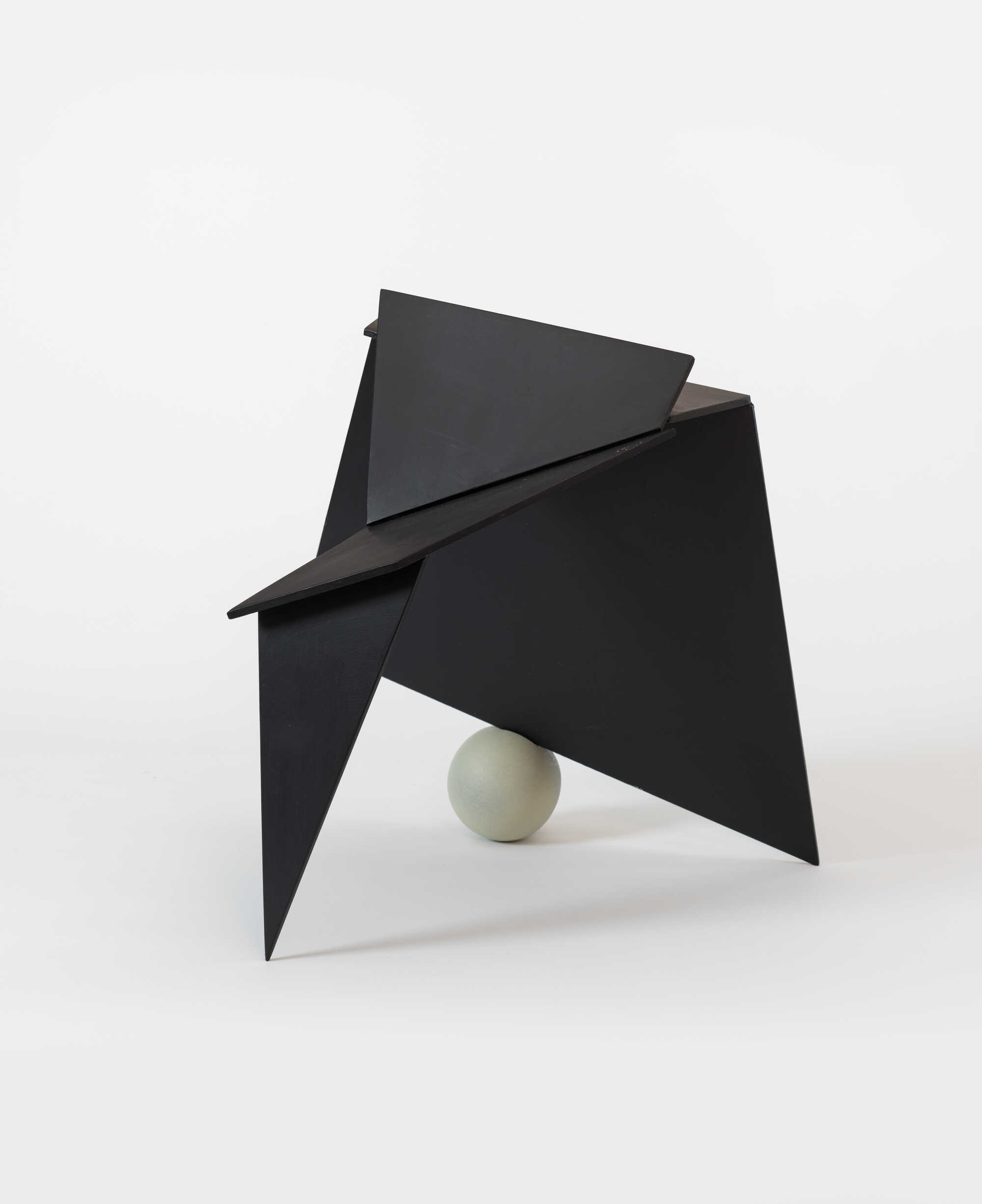
With Future Collapses, Past Rises, Neuer Berliner Kunstverein (n.b.k.) presents a new exhibition by Katja Strunz that brings together numerous approaches and techniques from the artist’s practice. The exhibition features lacquered steel sculptures referencing principles of folding and collapsing, alongside origami-like collages based on high-resolution satellite imagery showing the transformation of the Earth’s surface by human impact. Both groups of works bear witness to a balance between becoming and passing away. By highlighting the multitude of perspectives generated through the artistic process of deliberately folding material, they emphasize the potentiality of constant change. The selected works are supplemented by found objects and new contemporary historical references. The n.b.k. Showroom becomes a place where different pasts arise and enter into new relationships with a continually collapsing future.
Strunz’s most recent works are discursively shaped by the writings of physicist Anders Levermann and cultural theorist Aleida Assmann, among others. In his book Die Faltung der Welt (The Folding of the World, 2023), Levermann outlines measures to counter exponential economic and population growth, in the shadow of
which the destruction of human habitats looms. Using sober mathematical principles from chaos research and concrete case studies, he illustrates the kind of dynamic transformations necessary to prevent a climate catastrophe – without sacrificing prosperity and development. At the center of his reflections is the “creative” phenomenon of folding, which occurs in theoretical physics when a system strives for free movement within a limited space. Accordingly, the planet’s existing “folding limits” must be respected and human action adapted to them; Levermann is not concerned with stagnation or degrowth, but with an exploratory adaptation that generates innovation by transforming the existing and promoting diversity.
Strunz’s works embody precisely this movement: “I pursue the intention of setting a process in motion that can develop, unfold, and fold up again in all directions. The dynamics arise from the tension between the limits I set and the open possibilities for changes of direction within them.” In her series In Formation (2025), the artist works for the first time with satellite images from the analysis company Planet Labs PBC, founded by NASA scientists, which continuously documents the Earth’s surface at a data acquisition rate of over 30 terabytes per day. Strunz folds and collages a selection of these photographs, redefining the boundaries of the depicted landscapes in ever-new constellations and allowing them to encounter one another in structures that are as crystalline as they are corporeal. In the exhibition at n.b.k., these are accompanied by numerous other collage works using hand-scooped and hand-dyed paper – the Pulp Paintings – which illustrate the breadth of Strunz’s work with the medium of paper collage.
Metal sculptures are positioned as counterpoints to the wall works. These are also based on the principle of folding and, with their multitude of possible viewing angles, further emphasize the temporality of every spatial experience. Central to the dynamics expressed in Katja Strunz’s works is a sequentiality without a fixed order: the folding in, folding over, and re-folding embodied by the works represents a non-linear temporal order that produces ever-new connections. Continuities are suspended by moments of compression, fragmentation, or collapse; the idea of a final, ideal form is called into question and replaced by a constant process of breaking in, around, and open.
Here, Strunz references, among others, the theories set forth by Aleida Assmann in her book Is Time Out of Joint? On the Rise and Fall of the Modern Time Regime (2013; English edition 2020). Much as Levermann turns against a linear, one-dimensional idea of progress and growth, Assmann describes a new understanding of time that emerged in late modernity or postmodernity. While modernity was characterized by “an emphatic orientation toward the future, accompanied by a simultaneous devaluation of the past and tradition,” she argues that this changed with the geopolitical upheavals of the late 1980s and the experience of an “exhausted future” in the form of pollution, climate change, overpopulation, and an aging society. A theory of memory or culture of remembrance has emerged that views the past as the basis for the formation of identity and meaning in the present. In a new “pathology of time consciousness,” trauma also became a psychological and discursive cipher for the notion that the past continues to have an effect. What was once experienced remains present in symbols, is passed on in narratives, and can be mobilized in this sense – for division and polarization, but also for recognition, reconciliation, and the overcoming of opposites.
Strunz’s works embody this constant process of negotiation and adaptation: inscribed along their fold lines is a “post-traumatic” contraction and expansion of space and time – of here and there, of then and now. It is these associated circular movements and multiplications in temporal thinking that characterize the work of Katja Strunz.
Biography
Katja Strunz (*1970 in Ottweiler / Germany) lives and works in Berlin. She is known for her sculptures, wall works, large-scale installations, and works on paper, in which she explores the interaction of time and space. While still a student, she gained recognition for precise interventions in existing architecture. Since the early 2000s, she has continually advanced her exploration of the philosophical and physical principles of space-time, developing an abstract formal language realized across a diverse range of materials.
Her work has been presented at numerous national and international institutions, including: Muzeum Sztuki, Łódź (2025); Kestner Gesellschaft, Hannover (2023); Pinakothek der Moderne, Munich (2020); Kunstmuseum Bonn (2020); Indianapolis Museum of Contemporary Art (solo, 2019); Haus Konstruktiv, Zurich (2019); São Paulo Biennale (2013); Berlinische Galerie (solo, 2013); Camden Arts Centre, London (solo, 2009); Centre Pompidou, Paris (2009); Carnegie Museum of Art, Pittsburgh (2008); Museum Haus Esters, Krefeld (solo, 2006).