Deutschland
Susanne Specht
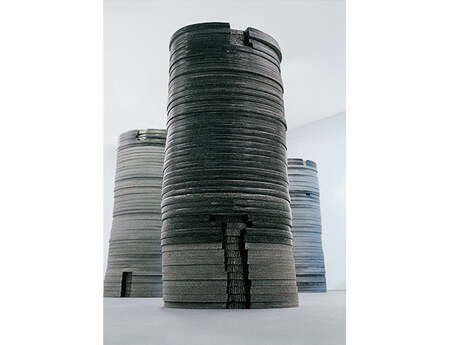
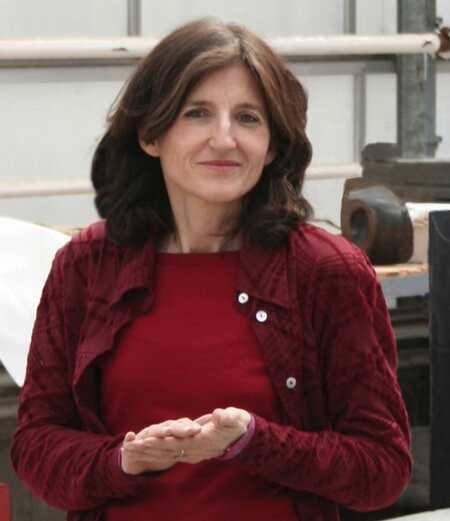
The artistic development of sculptor Susanne Specht is characterized by a rigorous, process-driven practice where each new creative phase evolves organically from the previous one. Following her studies at the Berlin University of the Arts (UdK) (1980–1986), stone sculpture formed the core of her early work. A central and profound milestone of this period was her 18-year intensive exploration of the rare metamorphic rock Eklogit (1993–2011), whose specific density and structural properties permanently shaped her sculptural language.
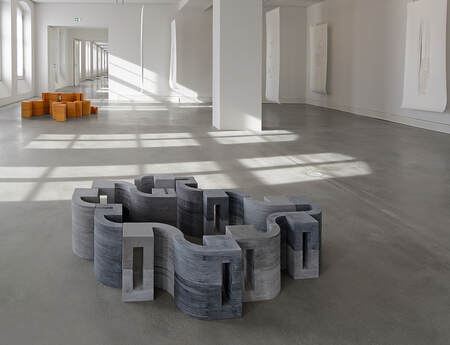
In 2006, Specht underwent a fundamental conceptual shift: she distanced herself from unique stone sculptures and pivoted towards working with concrete modules. These serial elements provided the foundation for experimenting with large-scale modules in alternative materials, unlocking entirely new modes of plastic expression. A prominent example from this phase is the large-scale, three-part public artwork "Mäandercode" located at the Grünzug Halemweg in Berlin, which demonstrates her understanding of site-specific, architectural, and structural spatial systems.
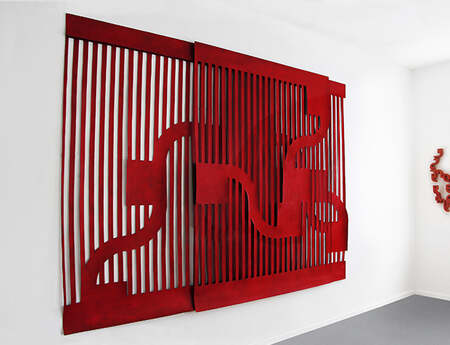
Since 2008, Specht has been experimenting with a dynamic range of materials, guided by a principle of inherent logic: one material invariably conditions the next. Through exploring flexible structures made of cellular rubber and the interactivity of magnetic walls, her path ultimately led to highly concentrated, spatial-graphic works on paper. This development is also reflected in her fifteen-year tenure as a Professor of Artistic Foundations and Experimental Spatial Design at the Niederrhein University of Applied Sciences (designkrefeld) (2008–2023).
Her work is continuously presented in major institutions, including her extensive retrospective "ab ovo" at the ZAK Center for Contemporary Art (Zitadelle Spandau) in 2021, as well as museum exhibitions at Haus Lange in Krefeld (2023) and the kunstraum friesenstrasse in Hannover (2023).